
Arrow Keys Not Working In Excel? Here's How to Fix It
Apr 13, 2023
Quick answer: If the arrow keys scroll the whole sheet instead of moving the selected cell, Scroll Lock is on. Press the Scroll Lock key to turn it off. On a laptop with no Scroll Lock key, open the Windows On-Screen Keyboard and click ScrLk. On a Mac, press Fn + Shift + F14.
Last updated: August 18, 2026
Arrow keys not working in Excel is almost never a broken keyboard. If the arrows work in every other program and only misbehave in Excel, the cause is a setting, and there are only about nine of them worth checking.
The fastest way to narrow it down is to notice exactly what happens when you press an arrow key. Does the whole grid slide while the green selection box stays put? Does nothing move at all? Does the selection jump straight to the last row? Each of those points at a different cause, and the table below maps them out.
Get our free Excel formulas cheat sheet
Plus new tutorials and template drops. Enter your email and we'll send it over.
What is on this page
- The diagnostic table: match your symptom to the cause
- How do I turn off Scroll Lock in Excel?
- How do I turn off Scroll Lock with no Scroll Lock key?
- How do I turn off Scroll Lock on a Mac?
- Why does the status bar still say Scroll Lock?
- Are frozen panes making the arrow keys look broken?
- Why do the arrow keys select cells instead of moving the text cursor?
- What are transition navigation keys, and why do they break the arrows?
- Can a protected sheet stop the arrow keys?
- Are Sticky Keys or Filter Keys involved?
- Could an add-in be intercepting the arrow keys?
- Why does one arrow press jump me to row 1048576?
- Frequently asked questions
If it is easier to follow along with a video, you can also watch our full tutorial below with four solutions to fixing your arrow keys in Excel.

The diagnostic table: match your symptom to the cause
Find the row that describes what your screen is doing, then jump straight to that fix.
| What happens when you press an arrow key | Cause | Fix |
|---|---|---|
| The whole sheet scrolls, the selected cell stays put | Scroll Lock is on. This is the classic cause | Press Scroll Lock, or use the On-Screen Keyboard |
| Nothing moves at all, in Excel or anywhere else | Hardware or driver problem, not Excel | Test the keys in Notepad first, then check the keyboard |
| The selection moves, but part of the sheet never scrolls into view | Frozen panes or split panes | View > Freeze Panes > Unfreeze Panes |
| Arrows insert cell references into a formula instead of moving | The cell is in Edit or Point mode | Press Esc to leave the formula |
| Arrows do nothing until you press Enter first, or behave oddly in formulas | Transition navigation keys, a legacy Lotus 1-2-3 setting | File > Options > Advanced, clear the checkbox |
| The selection skips over cells or refuses to enter some of them | Sheet is protected with locked cell selection disabled | Review > Unprotect Sheet |
| Keys repeat, stick, or need a long press to register | Sticky Keys or Filter Keys are enabled in Windows | Check Accessibility keyboard settings |
| Arrows stopped working right after installing a tool or plugin | An add-in is intercepting the keystrokes | Disable add-ins, or launch with excel /safe |
| One arrow press jumps to the very last row or column | End mode is active, or Ctrl is stuck down | Press End once to switch it off |
Rule of thumb: if the grid moves and the cell does not, it is Scroll Lock. If the cell moves and the grid does not, it is frozen panes. If nothing moves anywhere, it is the keyboard.
How do I turn off Scroll Lock in Excel?
Scroll Lock is a survivor from the original IBM PC keyboard. When it is on, the arrow keys scroll the viewport instead of moving the selected cell. Excel is one of the very few programs left that still honours it, which is exactly why the problem looks like an Excel fault.
The symptom is unmistakable. Press the down arrow and the entire grid slides up by one row while the green selection box stays exactly where it was.
How to fix it: press the Scroll Lock key once. On a full size keyboard it sits near Print Screen and Pause, and often has a small indicator light.
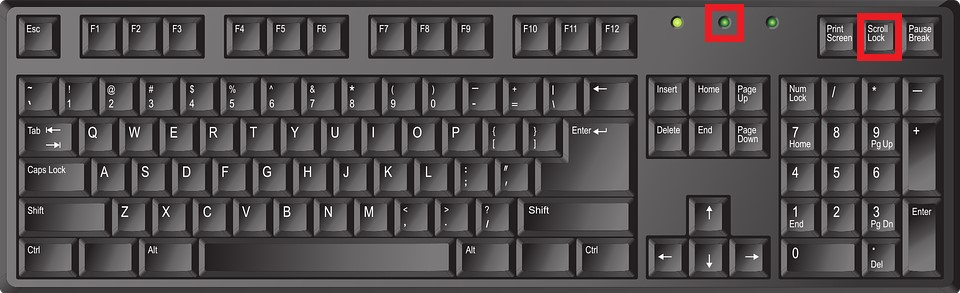
On some laptops the key is a secondary function, so you may need Fn + C, Fn + K, Fn + S, or Fn + Scroll Lock depending on the manufacturer. Microsoft lists the per-keyboard combinations in Turn Scroll Lock on or off.
Rule of thumb: Scroll Lock is a keyboard state, not an Excel state. Toggling it fixes every open workbook at once.
How do I turn off Scroll Lock with no Scroll Lock key?
Most modern laptops and compact keyboards ship without a Scroll Lock key at all, which leaves you stuck with a setting you cannot reach. Windows has a software keyboard that solves this in about ten seconds.
- Click the Search menu and type On-Screen Keyboard, then open it. You can also press Windows + Ctrl + O.
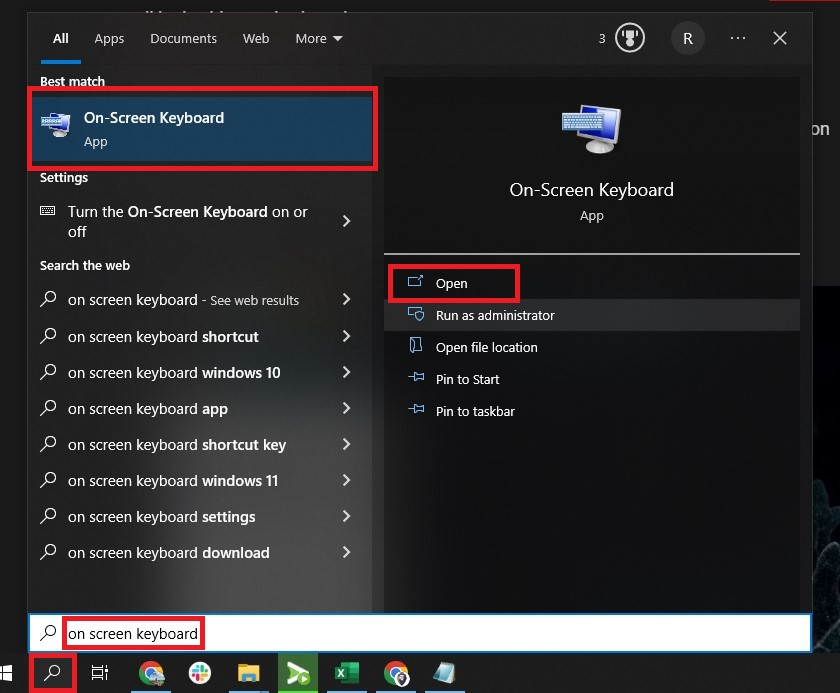
- Click ScrLk on the on-screen keyboard. If the key lights up, Scroll Lock was off and you have just turned it on, so click it once more.
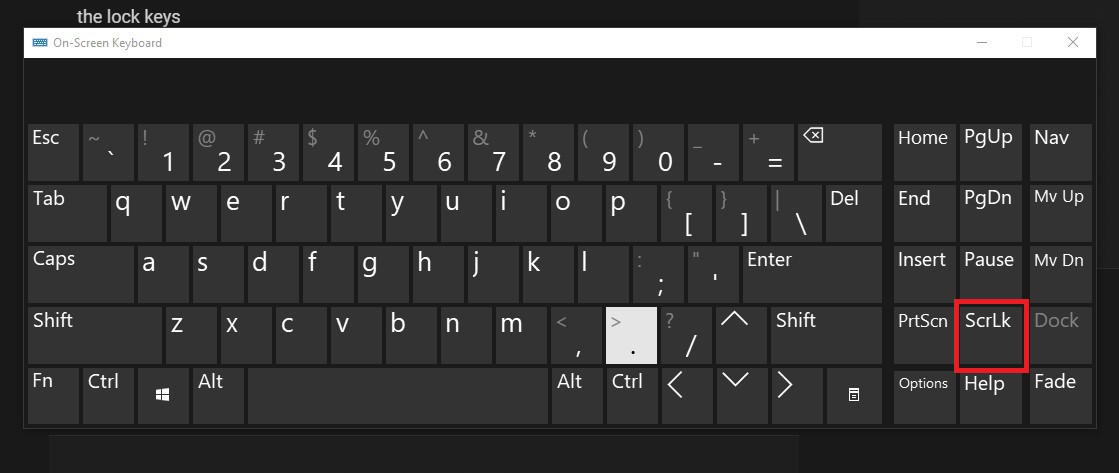
- Switch back to Excel and test an arrow key. Close the On-Screen Keyboard once it works.
If ScrLk is not visible on the on-screen keyboard, click Options and enable Turn on numeric key pad. That expands the layout to include the navigation cluster.
Rule of thumb: the On-Screen Keyboard toggles the real Windows Scroll Lock state. You do not need the physical key at all.
How do I turn off Scroll Lock on a Mac?
Mac keyboards have no Scroll Lock key, but Excel for Mac still respects the Scroll Lock state, and a workbook created on Windows can arrive with it set.
The quick method: press Fn + Shift + F14. On an external Apple keyboard with a full function row, Shift + F14 on its own often works. If your function keys control brightness and volume instead, hold Fn as well.
If the key combination does nothing, send the keystroke with a small AppleScript:
- Open Launchpad, then find and open Script Editor.
- Create a new document and paste in the script below.
tell application "Microsoft Excel"
activate
end tell
tell application "System Events"
key code 107 using {shift down}
end tell
- Press Command + S and save the file as FixExcelKeys.
- Open your Excel workbook, then click Run in Script Editor.
- The first run will ask for Accessibility permission. Approve it under System Settings > Privacy & Security > Accessibility, then run the script again.
Key code 107 is F14, so the script is simply pressing Shift + F14 for you against a keyboard that does not have the key.
Rule of thumb: on a Mac, Scroll Lock is Shift + F14. Everything else is a workaround for keyboards missing that key.
Why does the status bar still say Scroll Lock?
There is a widely repeated fix that says you can right-click the status bar at the bottom of Excel and click Scroll Lock to turn it off. That is worth clearing up, because it does not do what people expect.
Right-clicking the status bar opens the Customize Status Bar menu. Clicking Scroll Lock there controls whether Excel displays the indicator. It does not change the Scroll Lock state itself. Hiding the indicator makes the warning disappear while the arrow keys carry on scrolling.
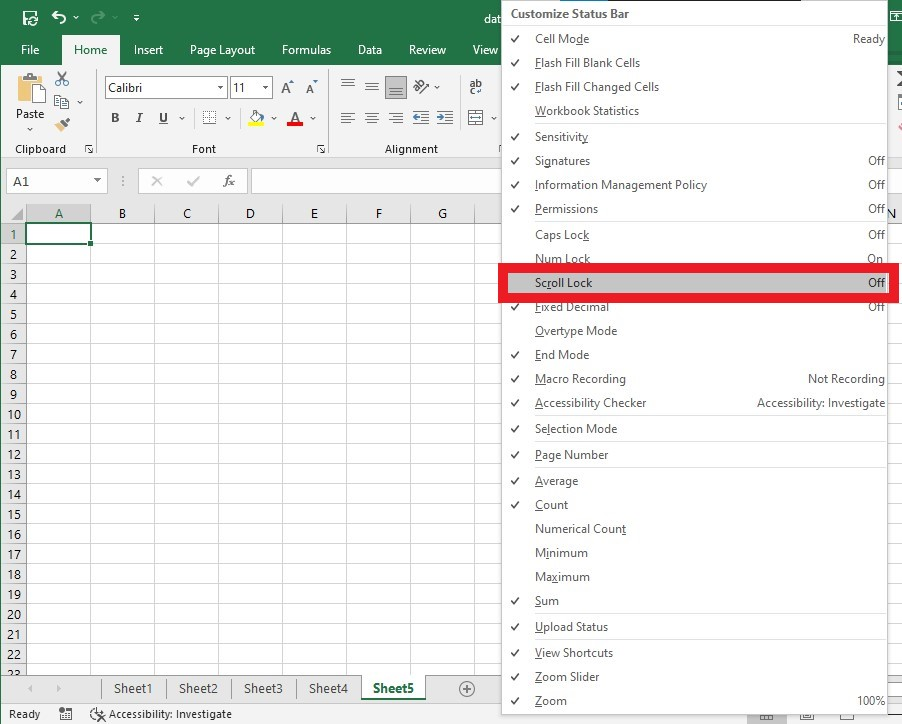
What the indicator is good for is diagnosis. Leave it switched on. If the status bar reads Scroll Lock, you have confirmed the cause in one glance without testing anything.
Rule of thumb: the status bar tells you Scroll Lock is on. Only the keyboard, or the On-Screen Keyboard, turns it off.
Are frozen panes making the arrow keys look broken?
Frozen panes are not a malfunction, but they produce a symptom that reads like one. With rows or columns frozen, arrowing past the frozen boundary moves the selection normally, yet the frozen region never scrolls. If you froze more rows than you meant to, the scrollable area can be a thin strip, so the sheet appears stuck.
A split window does something similar. Each pane scrolls independently, so the arrow keys only move within the active pane.
How to fix it:
- Go to View > Freeze Panes > Unfreeze Panes, then arrow around to confirm the behaviour is back to normal.
- Check View > Split as well. If the button is highlighted, click it to remove the split.
- Re-freeze deliberately. Select the cell below and to the right of everything you want to keep visible, then choose Freeze Panes.
Our step-by-step guide to how to freeze a row in Excel covers the setup in detail.
Rule of thumb: with frozen panes the cell reference in the Name Box still changes as you arrow. If the Name Box updates, the arrows are working and it is only a scrolling illusion.
Why do the arrow keys select cells instead of moving the text cursor?
When you are typing a formula and press an arrow key, Excel does not move the text cursor. It goes into Point mode and starts inserting cell references into the formula. Every arrow press adds or shifts a reference, which looks like the selection is jumping around at random.
Check the bottom left of the status bar. It reads Enter, Edit, or Point when a cell is active for input, and Ready when it is not.
How to fix it:
- Press Esc to abandon the entry and return to Ready mode. The arrows work immediately.
- Press Enter instead if you want to keep what you typed.
- To move the text cursor inside a formula rather than pointing at cells, press F2 first. That switches from Enter mode to Edit mode, where the arrows move through the formula text.
Rule of thumb: F2 toggles between editing the formula text and pointing at cells. Esc gets you out of both.
What are transition navigation keys, and why do they break the arrows?
This is the setting almost nobody knows about, and it is a genuinely obscure cause of odd arrow key behaviour.
Transition navigation keys is a compatibility option left over from Lotus 1-2-3, the spreadsheet Excel replaced in the early 1990s. When it is enabled, Excel remaps a set of keys to Lotus conventions. Slash opens the menu instead of typing a character, and the arrow keys behave differently while entering data or editing formulas.
It is usually switched on by accident, or inherited from a workbook or corporate template created decades ago.
How to check and fix it:
- Go to File > Options > Advanced.
- Scroll to the Lotus compatibility group at the very bottom.
- Clear Transition navigation keys.
- Also check Transition formula entry and Transition formula evaluation in the Lotus compatibility Settings for group just below. Both change how formulas behave.
- Click OK. No restart is needed.
Rule of thumb: if pressing the slash key opens the ribbon menu instead of typing a slash, transition navigation keys is on. That is the tell.
Can a protected sheet stop the arrow keys?
Yes, indirectly. When a worksheet is protected, whoever protected it chooses which actions stay available. If Select locked cells was left unchecked, the arrow keys cannot move the selection into any locked cell. On a sheet where most cells are locked, that feels exactly like broken arrow keys, because the selection either refuses to move or skips over large blocks.
How to confirm it: look at the Review tab. If the button reads Unprotect Sheet rather than Protect Sheet, protection is active. You can also try clicking a cell directly. If clicking does nothing either, it is protection rather than the keyboard.
How to fix it:
- Go to Review > Unprotect Sheet. Enter the password if one was set.
- If you need to keep the sheet protected, re-protect it and tick Select locked cells and Select unlocked cells in the permissions list.
If you do not have the password, our guide to unprotecting a sheet in Excel walks through the options.
Rule of thumb: if the mouse cannot select the cell either, the sheet is protected and the arrow keys were never the problem.
Are Sticky Keys or Filter Keys involved?
Two Windows accessibility features can affect the arrow keys, and they work in opposite directions.
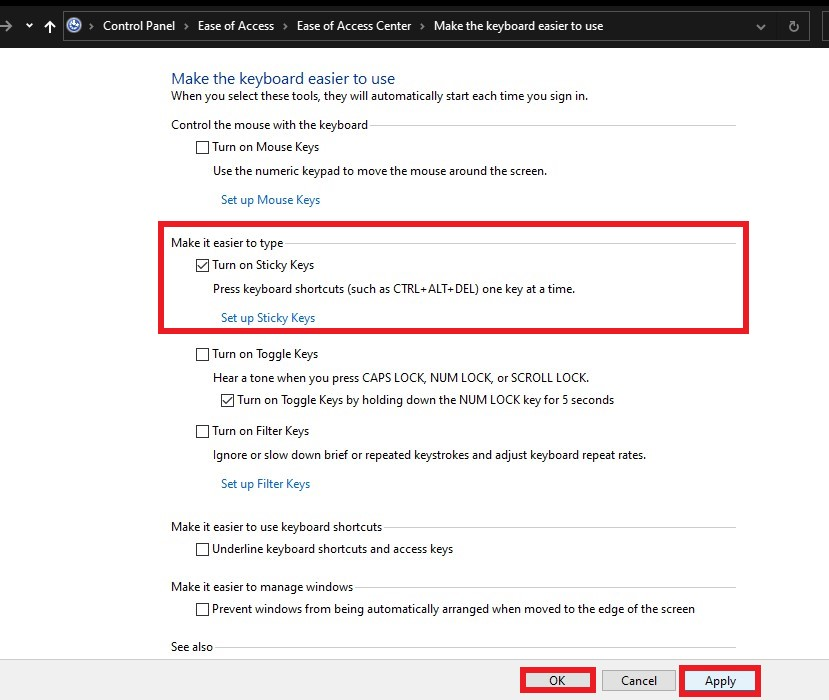
Filter Keys tells Windows to ignore brief or repeated keystrokes. It gets switched on accidentally by holding the right Shift key for eight seconds, which is easy to do. With it on, arrow presses feel dead unless you hold each one down. Turn it off.
Sticky Keys lets modifier keys latch instead of being held. If Ctrl or Shift has latched, the arrow keys jump to the edge of the data region or extend the selection instead of moving one cell. Some people find that toggling Sticky Keys on and off clears a stuck modifier, which is why it appears in older guides as a fix. It is worth trying, but the real goal is to make sure no modifier is latched.
How to check both:
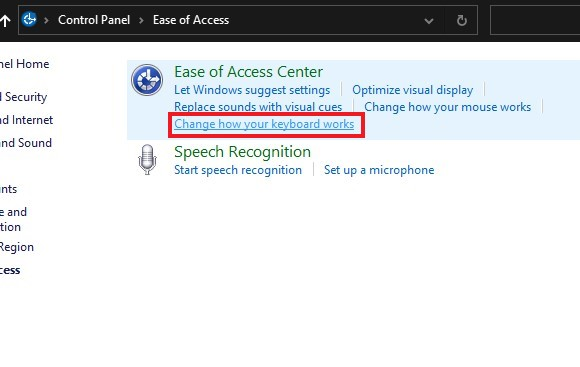
- On Windows 11, open Settings > Accessibility > Keyboard. On Windows 10 and earlier, go to Control Panel > Ease of Access > Change how your keyboard works.
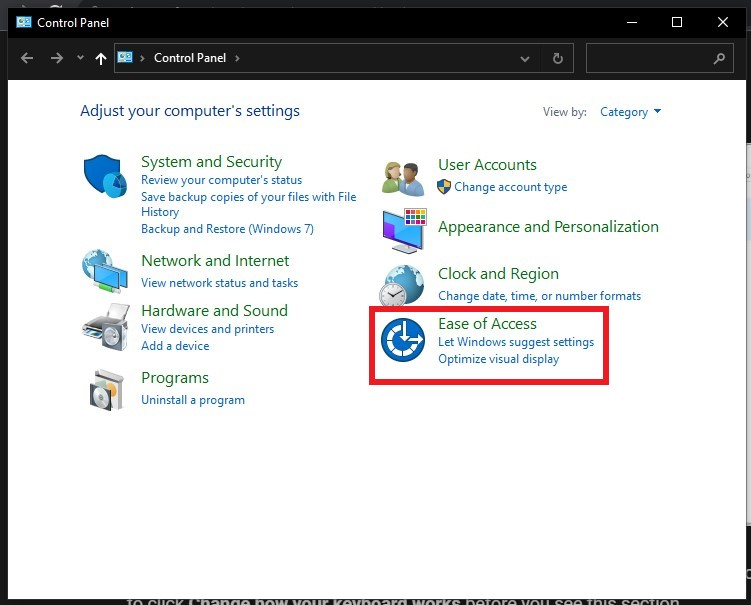
- Open the keyboard settings page.
- Check the state of Sticky Keys and Filter Keys, then apply.
- Tap Ctrl, Shift, and Alt once each to clear any latched modifier, then test the arrows in Excel.
Rule of thumb: if an arrow key jumps you to the end of the data instead of one cell, a modifier key is latched or physically stuck.
Could an add-in be intercepting the arrow keys?
Add-ins can register their own keyboard hooks. A poorly written one, or two that both claim the same keys, can swallow arrow key presses before Excel sees them. The clue is timing. If the arrows stopped working the same week you installed a reporting tool, a data connector, or a trading plugin, start here.
- Run Excel, go to File > Options, and click Add-ins in the left sidebar.
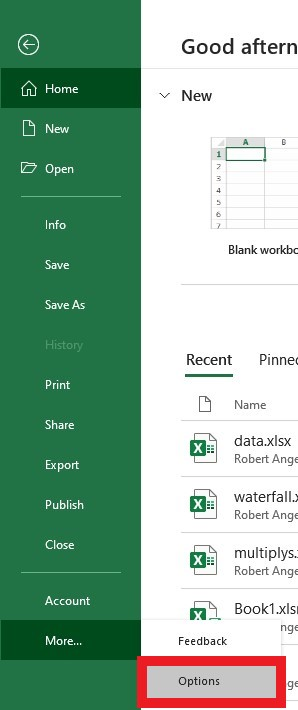
- Set the Manage dropdown to Excel Add-ins and click Go.
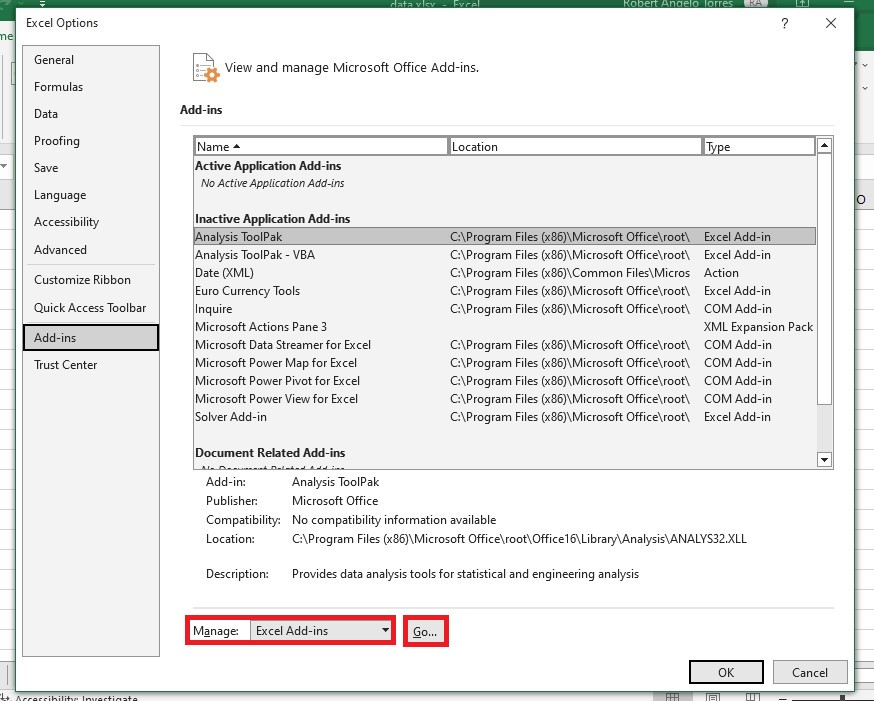
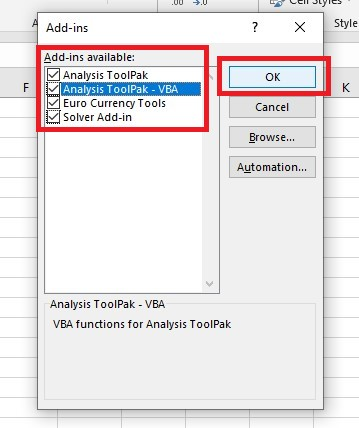
- Note which add-ins are currently checked, so you can put them back.
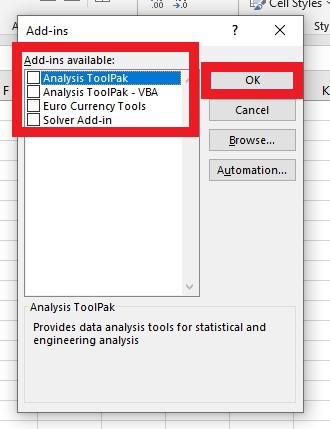
- Clear every checkbox, click OK, and restart Excel.
- Repeat the process with COM Add-ins in the same Manage dropdown. Most third party tools install there rather than as Excel Add-ins.
- Re-enable them one at a time to identify which one is responsible.
A faster test is Safe Mode. Hold Ctrl while launching Excel, or run excel /safe. Safe Mode loads no add-ins at all, so if the arrow keys work there, an add-in is definitely the cause.
Rule of thumb: Safe Mode answers the add-in question in thirty seconds. Do that before disabling anything one by one.
Why does one arrow press jump me to row 1048576?
If a single arrow press throws the selection to the far edge of the sheet, the arrow keys are working perfectly. Something is adding a modifier to them.
- End mode. Pressing End once puts Excel into End mode, shown in the status bar. The next arrow press jumps to the edge of the current data region. Press End again to switch it off.
- Ctrl is stuck or latched. Ctrl plus an arrow does the same jump. Tap Ctrl once on both sides of the keyboard to release it.
- Shift is latched. Shift plus an arrow extends the selection instead of moving it, so the highlighted block grows with every press. The status bar shows Extend Selection if F8 was pressed. Press F8 to clear it.
Rule of thumb: the status bar names the mode you are in. Ready means normal, anything else explains the behaviour.
Read more: Excel Text Wrapping Made Easy: A Step-by-Step Guide for Beginners
Read also: Excel Circular References: How to Find and Resolve Them
Read more: How to Organize a Spreadsheet by Date: A Quick Guide
Final Thoughts on Arrow Keys Not Working In Excel
Work down the diagnostic table from the top. Scroll Lock accounts for the large majority of cases, and the On-Screen Keyboard turns it off in seconds even on a laptop with no Scroll Lock key. If the arrows fail in Notepad too, the problem was never Excel.
For more easy-to-follow Excel guides and the latest Excel templates, visit Simple Sheets and the related articles section of this blog post.
Subscribe to Simple Sheets on YouTube for Excel video tutorials.
Frequently Asked Questions About Arrow Keys Not Working In Excel
Why are my arrow keys not moving cells in Excel?
Scroll Lock is on. When it is enabled, the arrow keys scroll the worksheet view while the selected cell stays where it is. Press the Scroll Lock key to turn it off, or open the Windows On-Screen Keyboard and click ScrLk if your keyboard has no Scroll Lock key.
How do I turn off Scroll Lock if my keyboard does not have the key?
Open the Windows On-Screen Keyboard by pressing Windows + Ctrl + O, then click ScrLk. The key highlights when Scroll Lock is active. Click it so it is no longer highlighted, switch back to Excel, and test an arrow key.
Why did my arrow keys stop working inside frozen rows and columns?
They have not stopped. With frozen panes, the frozen region never scrolls, so the sheet looks stuck even though the selection is moving. Watch the Name Box, which still updates. To confirm, go to View > Freeze Panes > Unfreeze Panes.
How do I turn off Scroll Lock on a Mac?
Press Fn + Shift + F14. On an external Apple keyboard with a full function row, Shift + F14 usually works on its own. If neither works, run a short AppleScript that sends key code 107 with the Shift modifier to Excel.
Why do the arrow keys insert cell references instead of moving?
The cell is in Enter or Point mode because you are part way through typing a formula. Press Esc to cancel or Enter to commit. To move the cursor within the formula text instead of pointing at cells, press F2 first.
What are transition navigation keys in Excel?
It is a Lotus 1-2-3 compatibility setting under File > Options > Advanced, in the Lotus compatibility group. When enabled it remaps several keys, including how the arrow keys behave during data entry. Clear the checkbox to restore normal navigation.
Can a protected worksheet stop the arrow keys from working?
Yes. If the sheet was protected without Select locked cells enabled, the selection cannot move into locked cells. Check the Review tab. If it reads Unprotect Sheet, protection is on. Unprotect the sheet, or re-protect it with Select locked cells ticked.
Why does one arrow press jump me to the last row of the sheet?
Either End mode is active, which you can see in the status bar and clear by pressing End again, or the Ctrl key is latched or physically stuck. Tap Ctrl on both sides of the keyboard, then test again.
Related Articles
How to Fix Excel Formulas Not Calculating, Working, or Updating
Excel Not Responding? How To Fix It
The Beginners Guide For Excel Keyboard Shortcuts
Excel Repeat Last Action: What is it and How Does it Work?
How to Unhide Columns in Excel: Everything You Need to Know
Excel Cannot Group Dates in Pivot Table: 3 Quick Fixes to Try
Want to Make Excel Work for You? Try out 5 Amazing Excel Templates & 5 Unique Lessons
We hate SPAM. We will never sell your information, for any reason.

