
How to Search in Excel Spreadsheet
Feb 03, 2026
To search in Excel, press Ctrl + F (Command + F on Mac), type your term, then click Find All to list every match at once. To search every tab in the file, click Options and change Within from Sheet to Workbook. Use filters to keep matching rows on screen, and XLOOKUP when you need to return a related value.
Last updated: August 18, 2026
Get our free Excel formulas cheat sheet
Plus new tutorials and template drops. Enter your email and we'll send it over.
Table of Contents
- Find vs Find All vs Filter vs lookup: which one should you use?
- Method 1: How do you search with Ctrl + F?
- How do you search all sheets in a workbook at once?
- Method 2: How do you find and replace text?
- Method 3: How do you search using filters?
- How do you search with wildcards, Match case and Match entire cell contents?
- How do you search formulas, values or comments?
- How do you search for formatting instead of text?
- Method 4: How do you search with the FIND and SEARCH functions?
- How do you search for a value and return another value?
- Why does Excel say it cannot find what you are looking for?
- Tips and best practices
- Frequently Asked Questions
Working in a large Excel spreadsheet can make it hard to find the exact data you need. Instead of scrolling through hundreds of rows, you can use built-in Excel tools to search quickly and accurately.
The catch is that Excel has four different search tools that do four different jobs. Find jumps you to a cell. Find All lists every match. Filters hide everything that does not match. Lookup functions return a related value from another column. Picking the wrong one is why most searches feel slow.
This guide covers all four, plus the options almost nobody uses, like searching every tab in a workbook at once and searching inside formulas rather than results.
If you use Google Sheets, you can also check out our guide on how to search in Google Sheets.
Find vs Find All vs Filter vs Lookup: Which One Should You Use?
Before you open anything, decide what you actually want to happen when the match is found. That single decision picks the tool for you.
| Tool | What it does | Best for | Updates automatically? |
|---|---|---|---|
| Find (Ctrl + F) | Jumps the cursor to one match at a time | Finding a single name, invoice number or typo | No |
| Find All | Lists every match with sheet, cell address and value | Counting matches or selecting them all at once | No |
| Filter | Hides every row that does not match | Reviewing, printing or copying a subset of rows | Yes, when you reapply |
| SEARCH / FIND functions | Returns the position of text inside a cell | Flagging rows that contain a keyword | Yes |
| XLOOKUP / VLOOKUP | Finds a value and returns a different value from the same row | Looking up a price, email or status by ID | Yes |
Rule of thumb: if you want to go somewhere, use Find. If you want to see a list, use Find All. If you want to work with the results, use a filter. If you want an answer in a cell, use a function.
Method 1: How Do You Search an Excel Spreadsheet With Ctrl + F?
The quickest way to search in an Excel spreadsheet is the keyboard shortcut Ctrl + F. This opens the Find and Replace dialog box and locates specific text and numbers across your cells in seconds. It works the same on Windows and Mac.
Here is a step-by-step guide on how to search for a name in an Excel spreadsheet:
- Open your spreadsheet in Microsoft Excel
- Click any cell (this becomes the cell where the search begins)
- Press Ctrl + F on Windows or Command + F on Mac

- The dialog box appears with a text box at the top
- Type your search term into the box
- Select Find Next to move through results one by one
- Choose Find All to display every match and its position in the sheet
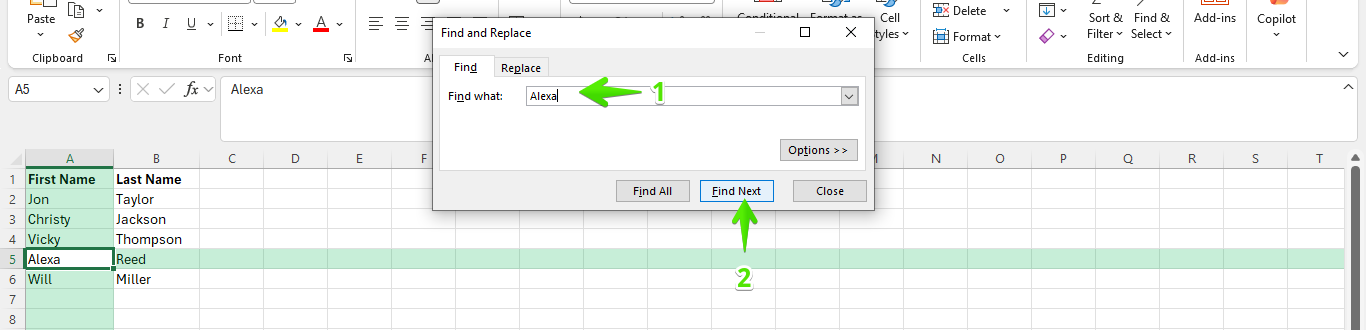
What is the difference between Find Next and Find All?
Find Next moves the selection to the next match and forgets the rest. Find All returns a results pane listing the workbook, sheet, cell address and value for every hit, and it tells you the total count at the bottom.
The part most people miss: you can click any row in the Find All list to jump to it, or press Ctrl + A while the list is focused to select every matching cell at once. That lets you colour, delete or format all matches in one move.
Quotable rule: Find All is the only Excel search that gives you a count of matches without writing a formula.
How Do You Search All Sheets in a Workbook at Once?
By default Excel only searches the active sheet, which is why a search can fail on data you know exists. To search every tab:
- Open the Find and Replace dialog box with Ctrl + F.
- Click the Options button in the bottom right of the dialog.
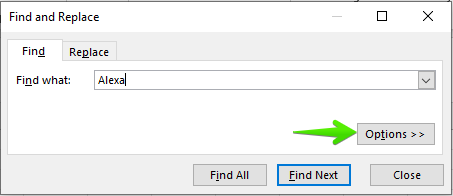
- Change the "Within" dropdown from "Sheet" to "Workbook".
- Click Find All. The results list now includes a Sheet column so you can see which tab each match lives on.
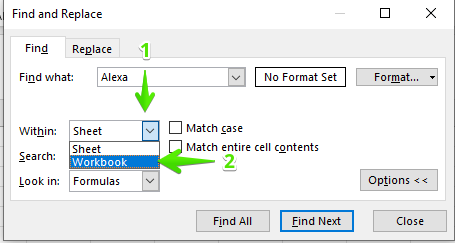
Two things worth knowing. The Within setting is sticky, so once you set it to Workbook it stays that way for the session. And a workbook search skips very hidden sheets, so if a value refuses to appear, unhide everything first.
Quotable rule: Excel searches one sheet unless you tell it otherwise. Within: Workbook is the single most useful setting in the Find dialog.

Method 2: How Do You Find and Replace Text in Excel?
If you need to find something and change it at the same time, use Replace. This is the fastest way to correct a repeated spelling, swap a supplier name, or clean up an imported file.
- Open the Replace dialog by pressing Ctrl + H, or click the Replace tab in the Find box.
- In the "Find what" text box, type the word you want to change.
- In the "Replace with" text box, type the new value.
- Click Replace to change one at a time, or Replace All to update everything in scope instantly.
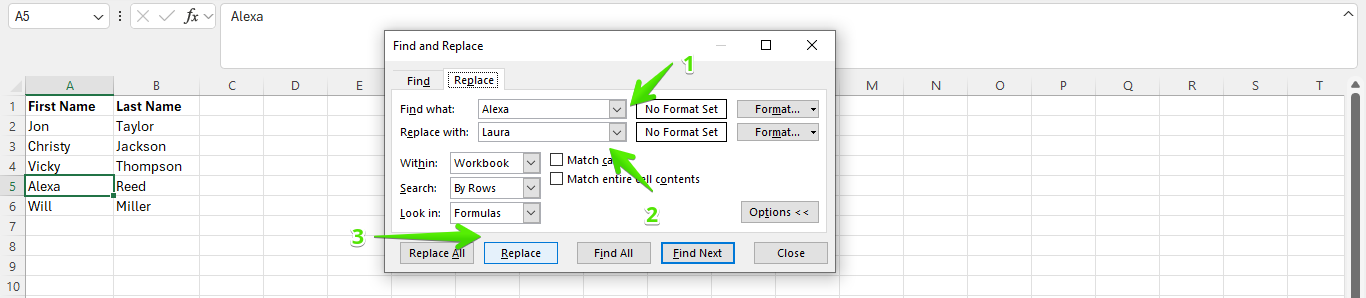
Two guardrails. Replace All obeys the Within setting, so if it is set to Workbook you will change every sheet, not just the one on screen. And Replace All cannot be undone selectively, so run Find All first to see exactly how many cells you are about to change.
Quotable rule: always run Find All before Replace All. The match count tells you whether the replacement is safe.
Method 3: How Do You Search Using Filters in Excel?
Find jumps to a cell. Filters do something different: they hide every row that does not match, so you can read, copy, print or chart only the rows you care about.
- Select any cell inside your data table
- Open the Data tab, then turn on Filters
- Small drop-down arrows appear in each column header
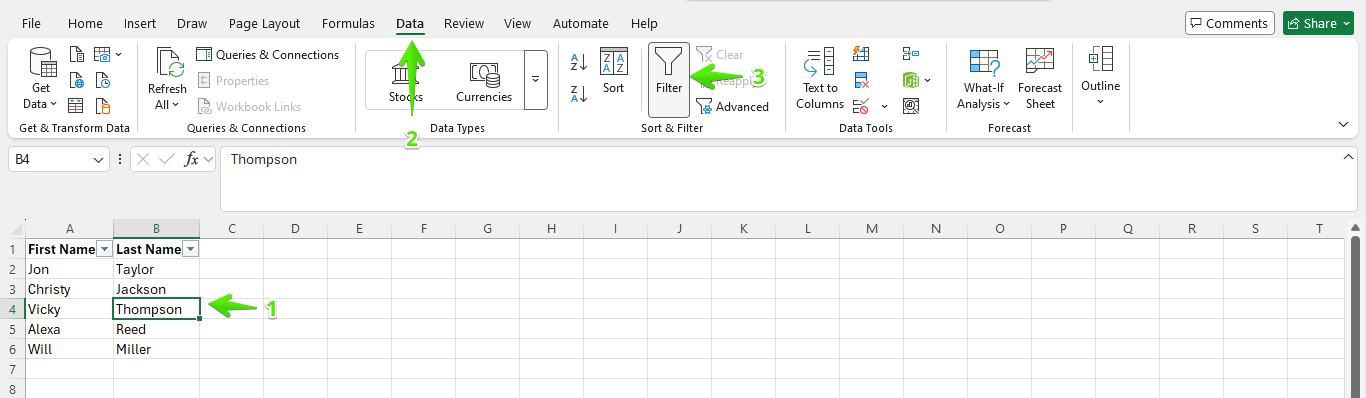
- Click the arrow in the column you want to search
- Use the search box inside the filter dropdown to type your search term
- Select or deselect values to display only matching results
- Click OK to apply the filter
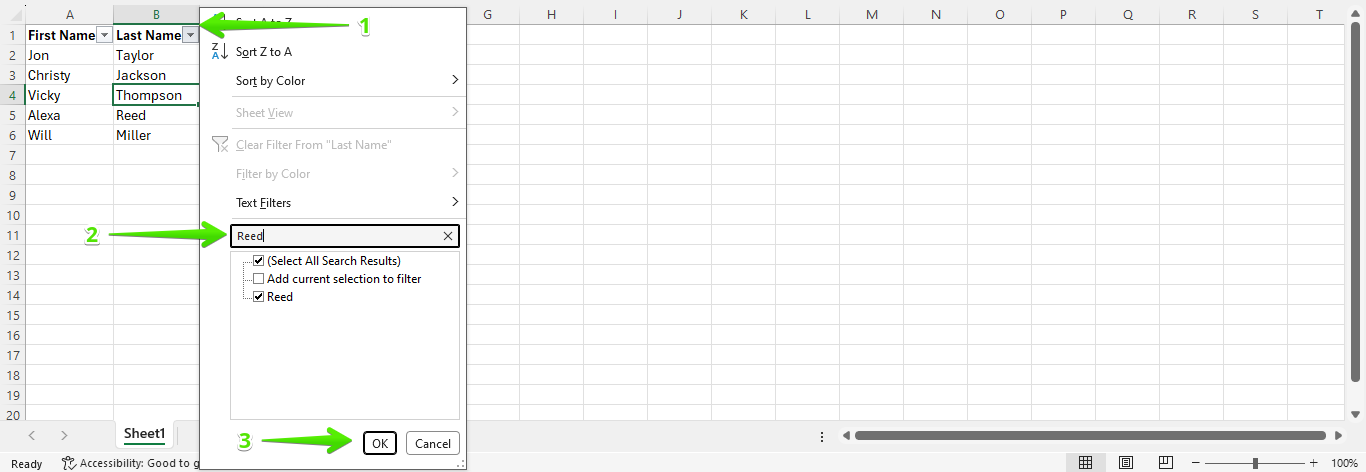
How do you search for more than one term at once?
Type your first term in the filter search box, tick the results, then click the arrow again, type the second term, and tick Add current selection to filter. That checkbox is how you build an OR search across several keywords in the same column.
Advanced text filters
For more control, open "Text Filters" from the dropdown. This lets you search for:
- Text that "Begins With" or "Ends With" certain characters.
- Values that are "Does Not Contain" or "Not Equal To" your search term.
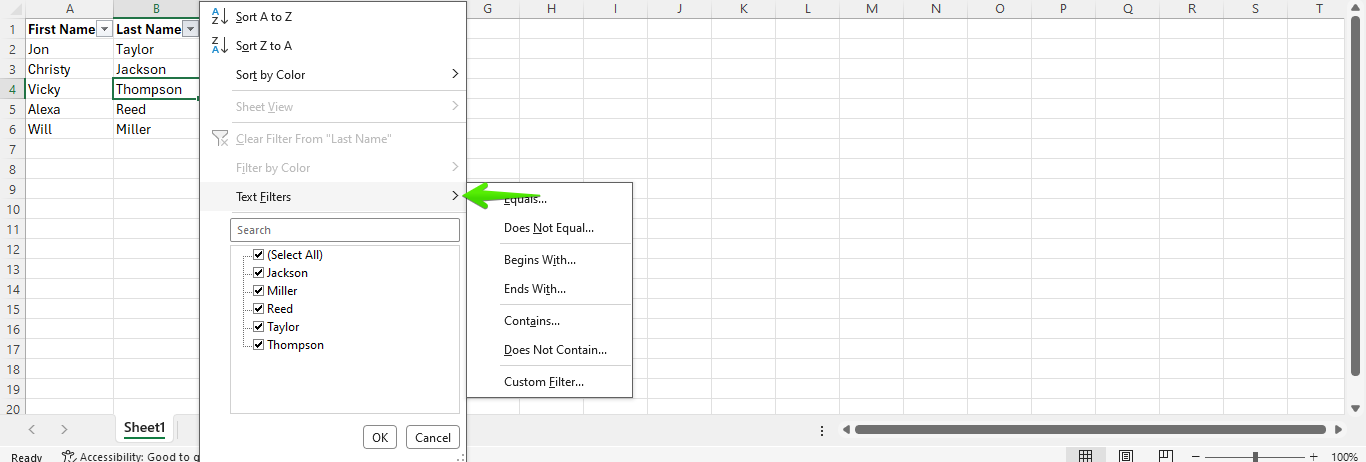
Quotable rule: a filtered view changes what you see, not what Find searches. Find still looks at hidden rows unless you explicitly select the visible cells first.
Read more: How to Clear Filters in Excel.
How Do You Search With Wildcards, Match Case and Match Entire Cell Contents?
Click Options in the Find dialog and three settings appear that change results dramatically.
| Setting or character | What it does | Example |
|---|---|---|
| Asterisk (*) | Any number of characters, including none | Ex* finds Excel, Example, Exit |
| Question mark (?) | Exactly one character | t?p finds top and tip, not trap |
| Tilde (~) | Escapes a wildcard so you can find it literally | ~* finds a real asterisk in the text |
| Match case | Makes the search case sensitive | Finds Apple but not apple |
| Match entire cell contents | Only matches cells that contain nothing else | "Sarah" will not match "Sarah Mitchell" |
Quotable rule: Excel's Find is not case sensitive by default. If a capitalisation search is returning too much, tick Match case before you rewrite anything.
How Do You Search Formulas, Values or Comments?
The Look in dropdown in the Find Options is the setting that decides whether Excel searches what you see or what is underneath.
- Formulas searches the underlying formula text. Use this to find every cell that references a sheet name, a stray hard-coded number, or an old workbook link.
- Values searches the displayed result. Use this when a cell shows 1,250 but the formula behind it is =B4*C4.
- Comments or Notes searches the review notes attached to cells rather than the cells themselves.
This is the fix for the most confusing search failure in Excel: searching for a number that a formula produced. Look in: Formulas will never find it, because the formula does not contain that number. Switch to Look in: Values.
Note that Replace only works with Look in: Formulas, which is why Excel greys out the other options as soon as you switch to the Replace tab.
Quotable rule: if you are searching for a number a formula calculated, set Look in to Values. If you are searching for the formula itself, set it to Formulas.
How Do You Search for Formatting Instead of Text?
Excel can search for a format with no search term at all, which is how you find every red cell, every bold heading or every cell using a specific number format.
- Press Ctrl + F and click Options.
- Click the Format button on the right.
- Either set the format manually, or choose Choose Format From Cell and click a cell that already has the formatting you want.
- Leave "Find what" empty and click Find All.
Excel returns every cell using that format. Combine it with Replace and the Format button on the Replace row to restyle them all in one pass.
One warning that catches people out: a saved format filter is sticky. If a later plain-text search returns nothing, open Options, click the Format dropdown arrow and choose Clear Find Format.
Quotable rule: a leftover format filter is the number one cause of a search that finds nothing on data you can see.
Method 4: How Do You Search With the FIND and SEARCH Functions?
The dialog box is a one-off action. When you want a search that updates itself as your data changes, you need a function. The SEARCH function looks for one piece of text inside another and returns the position where the match starts.
Syntax:
=SEARCH(find_text, within_text)
How to use it:
- Click a blank cell where you want the result to display
- Type =SEARCH( to start the function
- Enter the word or specific text you want to find inside quotes
- Add a comma, then select the cell that contains the text to check
- Close the bracket and press Enter
Example
=SEARCH("sarah", A2)
If "sarah" exists in that cell, Excel returns a number (the starting position). If not, you get a #VALUE! error.

To turn this into a clean TRUE/FALSE result:
- Use: =ISNUMBER(SEARCH("apple", A2))
- This returns TRUE when the text is found and FALSE when it is not, with no error to clean up
What is the difference between FIND and SEARCH in Excel?
They look identical and behave differently in two ways that matter.
| Behaviour | FIND | SEARCH |
|---|---|---|
| Case sensitive | Yes | No |
| Accepts wildcards (* and ?) | No | Yes |
| =FIND("A","banana") | #VALUE! error | 2 |
| Use it when | Capitalisation is meaningful, such as product codes | You just want to know if the text is in there |
Quotable rule: FIND is case sensitive and SEARCH is not. If your formula is returning #VALUE! on text you can see in the cell, you are probably using FIND with the wrong capitalisation.
How Do You Search for a Value and Return Another Value?
Plenty of people who search "how to search in Excel" actually want something different: type an ID and get back the matching name, price or status. That is a lookup, not a search.
XLOOKUP is the modern answer, available in Microsoft 365 and Excel 2021 and later:
=XLOOKUP(A2, Sheet2!A:A, Sheet2!C:C, "Not found")
That reads as: take the value in A2, find it in column A of Sheet2, return the matching value from column C, and show "Not found" instead of an error if there is no match. See Microsoft's official XLOOKUP function reference for the full argument list.
On older versions, VLOOKUP does the same job with three limitations: the lookup column has to be the leftmost column, you count the return column by number rather than selecting it, and you must add FALSE as the fourth argument to force an exact match.
=VLOOKUP(A2, Sheet2!A:C, 3, FALSE)
Quotable rule: if you want to land on a cell, use Find. If you want the answer written into a cell, use XLOOKUP.
Why Does Excel Say It Cannot Find What You Are Looking For?
The message "We couldn't find what you were looking for" on data that is clearly visible on screen is almost always one of these six causes. Work down the list in order.
| Cause | Fix |
|---|---|
| Scope is set to Sheet, data is on another tab | Options, then Within: Workbook |
| A range was selected before you pressed Ctrl + F | Click a single cell first, so Excel searches everything |
| Match entire cell contents is still ticked | Untick it in Options |
| A format filter is left over from a previous search | Format dropdown, then Clear Find Format |
| Look in is set to Formulas but the value is calculated | Switch Look in to Values |
| The cell contains extra spaces or a non-breaking space | Search a shorter fragment, or clean the column with TRIM |
Two more that are easy to miss. Protected sheets can block searching in locked cells, and a sheet set to "very hidden" in the VBA properties will not be searched even by a workbook-wide Find. Also worth checking: the value may be stored as text with a leading apostrophe, which changes what Excel considers a match.
Quotable rule: if Find fails on visible data, check scope first, then Match entire cell contents, then a leftover format filter. Those three explain most cases.
Tips and Best Practices for Searching in Excel
1. Start with the keyboard, not the ribbon
Ctrl + F to find, Ctrl + H to replace, Ctrl + G for Go To. Go To Special is the underrated one: it selects every blank cell, every formula or every constant in a range in a single click.
2. Search a fragment, not the whole string
Searching "Mitch" instead of "Sarah Mitchell" survives trailing spaces, middle initials and inconsistent capitalisation. Add wildcards only when a fragment is not enough.
3. Filter first when you want to work with the results
If the next thing you plan to do is copy, delete or chart the matches, filter rather than find. It keeps the matching rows on screen instead of making you chase them.
4. Use formulas for anything you will repeat
For recurring checks, use Excel formulas such as ISNUMBER(SEARCH(...)) or COUNTIF. These update themselves as the data changes, and they leave an audit trail that a manual search does not.
5. Search the entire workbook when you are unsure
If you do not know where the information lives, set the scope to Workbook and use Find All. The results list tells you the sheet name and the cell address in one view.
Final Thoughts
Searching in Excel is less about knowing Ctrl + F and more about knowing which of the four tools matches your goal. Find moves you. Find All lists and counts. Filters isolate. Functions answer.
The two settings that save the most time are Within: Workbook, which searches every tab at once, and Look in: Values, which searches what you can see rather than the formulas underneath. Between those two, most searches that "fail" start working immediately.
Frequently Asked Questions
1. What is the fastest way to search in an Excel spreadsheet?
Press Ctrl + F on Windows or Command + F on Mac, type the term, and press Enter. Click Find All instead if you want a list of every match with its sheet and cell address.
2. How do I search all sheets in an Excel workbook at once?
Press Ctrl + F, click Options, and change the Within dropdown from Sheet to Workbook. Then click Find All. The results list gains a Sheet column showing which tab each match is on.
3. How do I search for partial matches in Excel?
Use wildcards. An asterisk stands for any number of characters and a question mark stands for exactly one. To search for a literal asterisk or question mark, put a tilde in front of it.
4. How do I make my Excel search case sensitive?
Open Find, click Options, and tick Match case. In formulas, use FIND rather than SEARCH, because FIND is case sensitive and SEARCH is not.
5. How do I search for formulas rather than results in Excel?
In the Find Options, set the Look in dropdown to Formulas. This searches the underlying formula text, which is how you locate every cell referencing a particular sheet or an old external link.
6. Why does Excel say it cannot find something that is clearly on the screen?
The usual causes are scope set to Sheet instead of Workbook, a range accidentally selected before you searched, Match entire cell contents left ticked, a leftover format filter, Look in set to Formulas on a calculated value, or stray spaces in the cell.
7. What is the difference between FIND and SEARCH in Excel?
FIND is case sensitive and does not accept wildcards. SEARCH ignores case and does accept wildcards. =FIND("A","banana") returns an error while =SEARCH("A","banana") returns 2.
8. How do I search for a value and return a different value?
That is a lookup, not a search. Use =XLOOKUP(lookup_value, lookup_array, return_array, "Not found") in Microsoft 365 and Excel 2021 or later, or =VLOOKUP(value, range, column_number, FALSE) on older versions.
9. Can I search for cells by their colour or formatting?
Yes. Press Ctrl + F, click Options, click Format, then choose Choose Format From Cell and click a cell with the formatting you want. Leave the search box empty and click Find All.
10. How do I search only the rows a filter is showing?
Select the visible range first, then press Ctrl + F. Excel searches the current selection when more than one cell is selected, so hidden rows are excluded.
Related Articles:
How to Add a Trendline in Excel Online
Want to Make Excel Work for You? Try out 5 Amazing Excel Templates & 5 Unique Lessons
We hate SPAM. We will never sell your information, for any reason.

