
Excel Workbook vs. Worksheet: What's the Difference?
Dec 30, 2022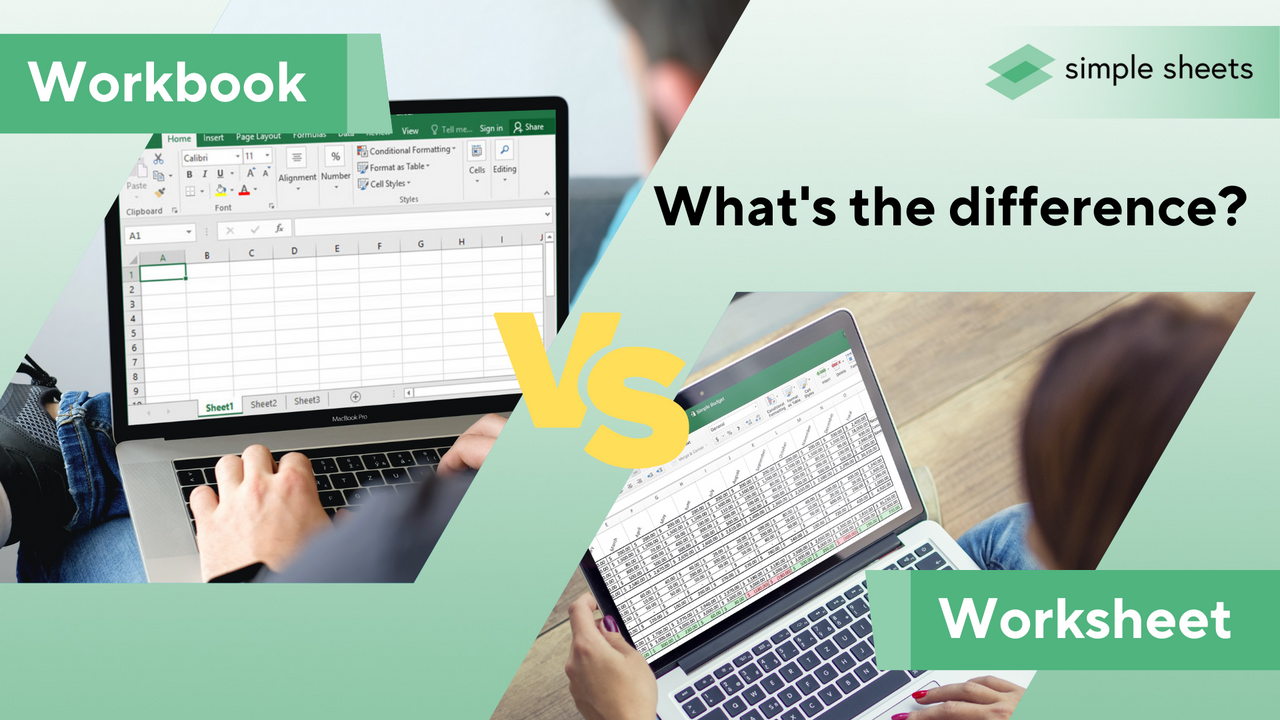
Last updated: August 19, 2026
An Excel workbook is the file you save and open, such as Budget.xlsx. A worksheet is a single tab inside that file. One workbook holds many worksheets, and every worksheet belongs to exactly one workbook. Excel calls the file a workbook and each tab a worksheet.
What is on this page
- What is the difference between an Excel workbook and a worksheet?
- What is an Excel workbook, and what does it contain?
- How do you create a workbook and add worksheets?
- How do you rename a worksheet in Excel?
- How do you delete a worksheet without losing data?
- How do you duplicate a worksheet in Excel?
- How do you reference a cell on another worksheet?
- Workbook, worksheet or spreadsheet: which word should you use?
- Frequently asked questions
What is the difference between an Excel workbook and a worksheet?
The difference is container versus contents. The workbook is the file on your drive. The worksheet is one grid of cells inside it, shown as a tab along the bottom of the Excel window.
| Workbook | Worksheet | |
|---|---|---|
| What it is | The Excel file itself | One tab of cells inside the file |
| What you see | A file such as Budget.xlsx in File Explorer or Finder | A tab such as Sheet1 at the bottom of the window |
| How many | One file at a time in a window | Limited by available memory, not a fixed number |
| How you create it | File, then New, then Blank Workbook | Click the plus sign next to the last sheet tab |
| How you name it | Save As, then type a file name | Double-click the tab, then type a name |
| How you delete it | Delete the file from your operating system | Right-click the tab, then choose Delete |
| Can it exist alone | Yes, a workbook can hold a single worksheet | No, a worksheet always sits inside a workbook |
The rule: if you can email it, it is a workbook. If you can click it at the bottom of the Excel window, it is a worksheet.
What is an Excel workbook, and what does it contain?
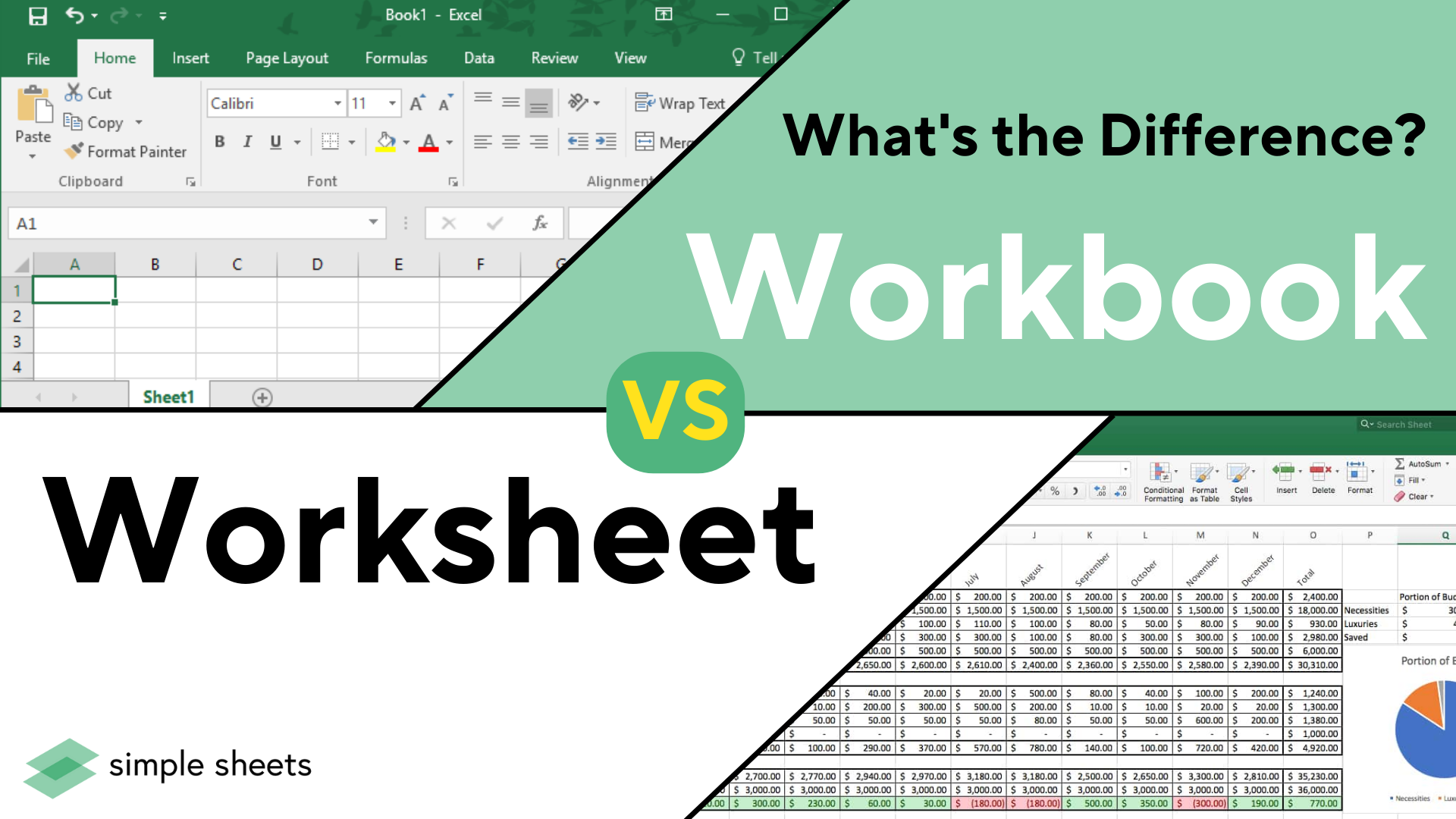
A workbook is the saved file, normally with an .xlsx extension. It carries everything the file knows about itself: every worksheet, the formatting on those worksheets, named ranges, charts, PivotTables, and any macros if you saved it as an .xlsm file.
That is why file-level actions belong to the workbook and sheet-level actions belong to the worksheet. Protecting a workbook stops people adding or deleting tabs. Protecting a worksheet stops people editing cells on that one tab.
There is no fixed cap on how many worksheets a workbook can hold. Microsoft lists the limit as available memory rather than a set number, so the practical ceiling is your machine. You can insert up to 255 sheets in a single operation, and repeat that as often as you need. The full list is in the official Excel specifications and limits documentation from Microsoft.
The rule: anything that survives closing and reopening the file is a workbook property. Anything scoped to one tab is a worksheet property.
Suggested read: Excel Waiting for OLE Action to Complete Error
How do you create a workbook and add worksheets?
Most of the time a single worksheet is enough. When one tab stops being enough, you add more rather than starting a second file.
To create a new workbook:
- Open Excel, or from an open file go to the File menu.
- Select New.
- Select Blank Workbook, or pick a template.
- Press Ctrl and S on Windows, or Command and S on a Mac, and give the file a name.
To add a worksheet to that workbook, click the plus sign to the right of the last sheet tab at the bottom of the window. The keyboard shortcut is Shift and F11.
To move between worksheets, click each tab, or press Ctrl and Page Down to go forward and Ctrl and Page Up to go back. To reorder tabs, drag one along the tab strip with your mouse and drop it where you want it.
How do you rename a worksheet in Excel?
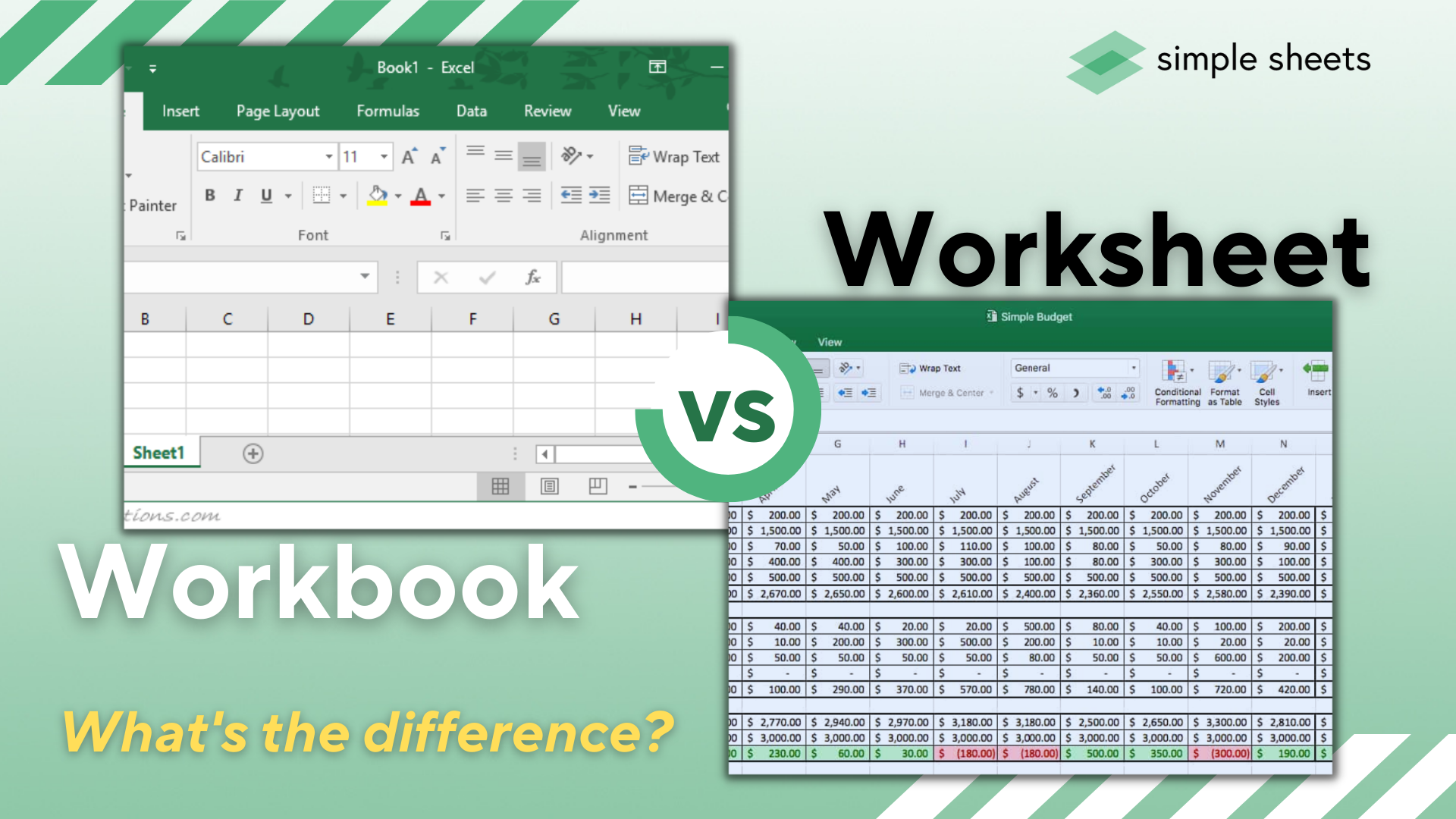
Names such as Sheet1 and Sheet2 tell you nothing six months later, and they make cross-sheet formulas hard to read.
- Double-click the sheet tab you want to rename.
- Type the new name.
- Press Enter.
You rename one tab at a time. Worksheet names have real constraints worth knowing before you build formulas on top of them: a name can be up to 31 characters, cannot be blank, cannot be the word History, and cannot contain a colon, a forward slash, a backslash, a question mark, an asterisk or square brackets.
The rule: rename tabs before you write formulas that point at them, because a name with a space in it forces you to wrap the sheet name in single quotes in every reference.
How do you delete a worksheet without losing data?
Deleting a worksheet is fast, and it is one of the few Excel actions you cannot undo with Ctrl and Z. Copy anything you still need to another tab first.
The quickest method is to right-click the sheet tab and choose Delete. You can also click the sheet tab, go to the Home tab, select Delete, then choose Delete Sheet.
One trap: if other worksheets contain formulas pointing at the tab you delete, those formulas return the #REF! error rather than recalculating. Check for dependencies before you delete a tab that has been in the workbook a while.
How do you duplicate a worksheet in Excel?
Duplicating a tab is how you reuse a layout without rebuilding it. A monthly timesheet, a per-client invoice or a scenario copy of a model all start as a duplicate of a tab that already works.
- Right-click the sheet tab you want to copy.
- Choose Move or Copy.
- In the Before sheet box, choose where the copy should land.
- Tick the Create a copy checkbox. This step is the one people miss, and without it Excel moves the tab instead of copying it.
- Select OK.
The faster method: hold Ctrl on Windows or Option on a Mac, then drag the sheet tab sideways along the tab strip. Excel drops a copy where you release it.
To copy a worksheet into a different file, open both workbooks first, then in the Move or Copy dialog change the To book dropdown to the other workbook.
The rule: a duplicate carries formatting and formulas, but formulas that referenced other tabs still point at the original tabs, not at the copy. Check your references after duplicating.
How do you reference a cell on another worksheet?
Worksheets inside a workbook are not sealed off from each other. A cell on one tab can pull a value from any other tab, which is what makes a multi-sheet workbook more useful than several separate files.
The syntax is the sheet name, an exclamation mark, then the cell address:
=Sheet2!B4pulls the value in cell B4 on Sheet2.='Q1 Sales'!B4does the same when the sheet name contains a space. The single quotes are required.=SUM(Sheet2!B4:B20)works exactly like a normal SUM, just pointed at another tab.=SUM(Jan:Dec!B4)adds cell B4 across every tab from Jan to Dec. This is called a 3D reference, and it only works when the tabs share an identical layout.
Referencing across workbooks instead of across worksheets uses the file name in square brackets, as in ='[Budget.xlsx]Q1 Sales'!B4. That link only updates while both files are open or when Excel refreshes the link, which is a common source of stale numbers.
The rule: keep related data in separate worksheets of one workbook rather than in separate workbooks. Cross-sheet references always recalculate. Cross-workbook references only recalculate when the source file is available.
Suggested read: How To Search in an Excel Spreadsheet?
Workbook, worksheet or spreadsheet: which word should you use?
Three words get used for two things, which is where most of the confusion starts.
| Term | What it means in Excel |
|---|---|
| Workbook | The precise term for the file. This is what Excel itself calls it. |
| Worksheet | The precise term for one tab inside the file. |
| Sheet | Everyday shorthand for a worksheet. Excel uses it too, in menu items such as Delete Sheet. |
| Tab | The clickable label at the bottom of the window. A tab and a sheet are the same object, seen from different angles. |
| Spreadsheet | Ambiguous. In casual use it means either the file or one tab, and in Google Sheets it officially means the file. |
Note the mismatch across products. In Google Sheets, the file is called a spreadsheet and each tab is called a sheet, so a Google Sheets spreadsheet is the equivalent of an Excel workbook, not an Excel worksheet. If you work across both tools, say workbook or file when you mean the whole thing and tab when you mean one grid, and nobody will misread you.
Frequently asked questions
What is an Excel workbook?
An Excel workbook is the file that contains one or more worksheets. It is what you save, name and email. Counting the tabs along the bottom of the window tells you how many worksheets that workbook currently holds.
Can you work on multiple worksheets at once?
Yes. Excel lets you switch between worksheets using the tabs at the bottom of the file, and you can group tabs to edit several at the same time. Hold Ctrl and click each tab to group them, and any typing or formatting applies to every tab in the group. Click a tab outside the group to ungroup.
How do I create a new workbook and worksheet?
Go to File, then New, then Blank Workbook to create a workbook. Click the plus sign next to the last sheet tab to add a worksheet. Shift and F11 does the same thing from the keyboard.
How many worksheets can an Excel workbook have?
There is no fixed limit. Microsoft lists the number of sheets in a workbook as limited by available memory. New workbooks start with a single sheet, and you can insert up to 255 sheets in one operation. In practice, performance degrades long before you hit any hard ceiling.
Is a spreadsheet the same as a worksheet?
Not reliably. In Excel a worksheet is one tab, while spreadsheet is a loose word people use for either the tab or the whole file. Google Sheets uses spreadsheet to mean the file, which is the equivalent of an Excel workbook. Use workbook and worksheet when precision matters.
What is the difference between a tab and a sheet in Excel?
None. The tab is the label you click, and the sheet is the grid it opens. They refer to the same worksheet, so renaming the tab renames the sheet.
Related Articles:
How to Delete Sheets in Excel: Deleting Multiple Sheets at Once
How to Add a Trendline in Excel Online
Want to Make Excel Work for You? Try out 5 Amazing Excel Templates & 5 Unique Lessons
We hate SPAM. We will never sell your information, for any reason.

