
The Sunburst Chart In Excel: Everything You Need to Know
Mar 14, 2023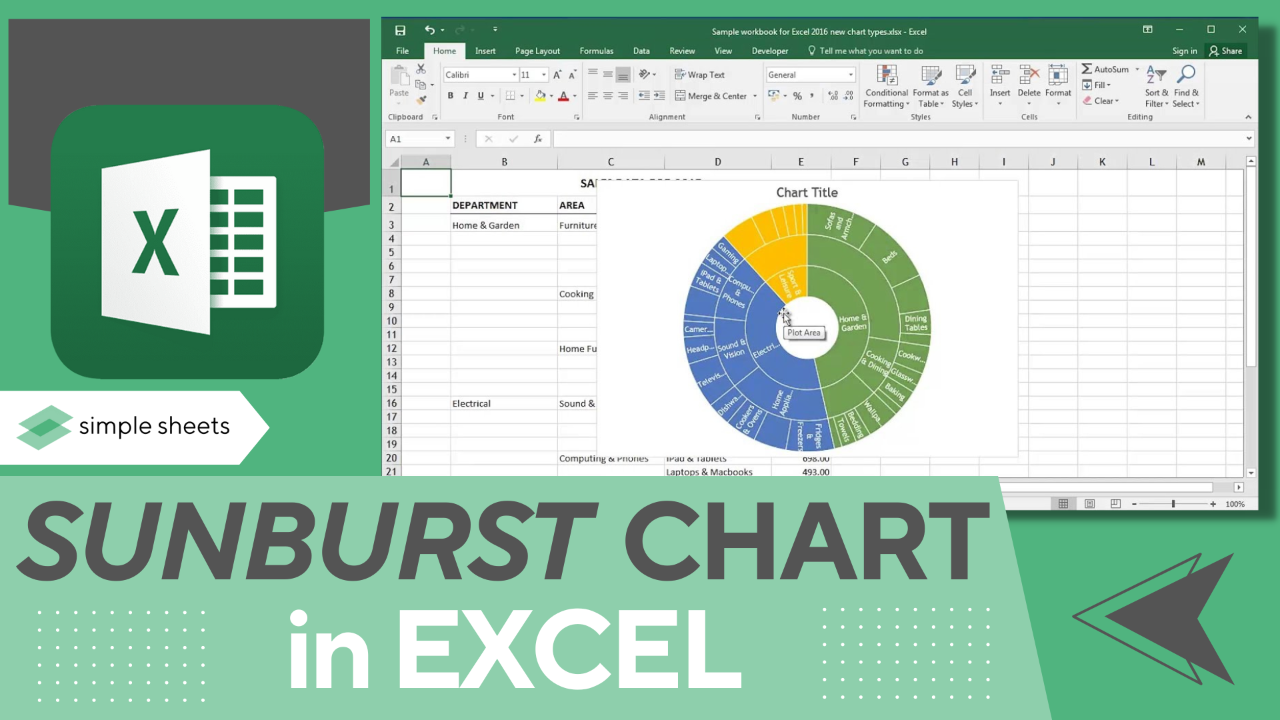
Last updated: August 25, 2026.
Quick answer: A sunburst chart in Excel shows hierarchical data as concentric rings, with the innermost ring as the top level. To build one, select your data, then click Insert > Insert Hierarchy Chart > Sunburst. Excel needs one column per hierarchy level and one value column, and the feature requires Excel 2016 or later.
Get our free Excel formulas cheat sheet
Plus new tutorials and template drops. Enter your email and we'll send it over.
On this page
- What is a sunburst chart in Excel?
- How should your data be laid out for a sunburst chart?
- How do you make a sunburst chart in Excel?
- How do you format the sunburst chart so it is readable?
- How do you move a sunburst chart to its own sheet?
- Which Excel versions have the sunburst chart?
- Why is the sunburst chart missing, greyed out, or wrong?
- Is a starburst chart the same as a sunburst chart?
- Sunburst vs treemap vs doughnut: which should you use?
- Can you make a sunburst chart in Google Sheets?
- Frequently asked questions
What is a sunburst chart in Excel?
A sunburst chart is a hierarchical chart, also called a ring chart, a sunburst diagram, or a radial treemap. Each ring is one level of the hierarchy. The innermost circle is the top level, and every ring outside it breaks its parent slice into smaller pieces.
With only one level of categories, a sunburst looks exactly like a doughnut chart. The chart only earns its keep once you have two or more levels, because that is when the outer rings start showing how each parent splits.
It is easy to read because it resembles a pie or doughnut chart, which makes it straightforward to understand and visualize each data point without training the reader first.
Rule to remember: a sunburst with one category level is just a doughnut chart with extra steps.
For a deeper look at when this chart type is the right choice, see our companion guide on what a sunburst chart is and when to use one.
How should your data be laid out for a sunburst chart?
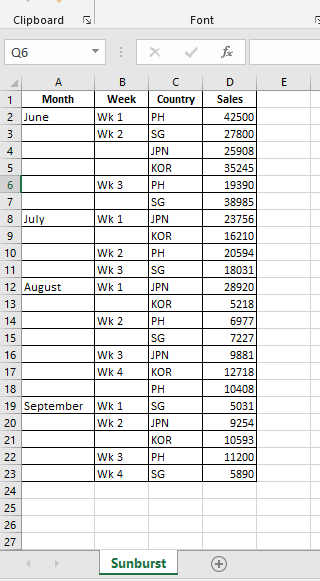
This is where most sunburst charts go wrong, and it is never mentioned in the chart dialog. Excel reads the hierarchy from the column order, left to right.
- One column per hierarchy level, arranged from the broadest level on the left to the narrowest on the right.
- One numeric value column, and it must be the last column in the selection.
- Repeated parent labels can be left blank on the rows underneath, or repeated on every row. Both work.
- No blank rows inside the block, and no merged cells.
A three-level layout looks like this:
| Region (level 1) | Country (level 2) | Store (level 3) | Units sold |
|---|---|---|---|
| Americas | United States | Store 1 | 420 |
| Store 2 | 310 | ||
| Canada | Store 3 | 190 | |
| Europe | Germany | Store 4 | 265 |
| Spain | Store 5 | 140 |
Selecting all four columns gives you three rings: Region in the middle, Country around it, Store on the outside, sized by Units sold.
Rule to remember: the value column goes last, and everything to its left becomes a ring in the order you put it there.
How do you make a sunburst chart in Excel?
Three steps, on Windows and Mac alike. Microsoft documents the same path in its official guide to creating a sunburst chart in Office.
- Prepare and select your data table, including the header row and the value column.
- Go to the Insert tab and click Insert Hierarchy Chart in the Charts group.
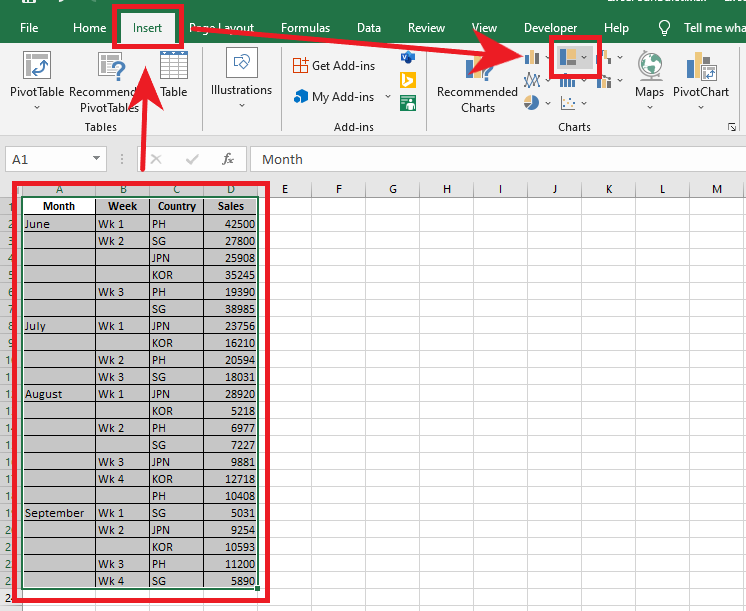
- In the Insert Hierarchy Chart drop-down, choose Sunburst. The chart appears on the worksheet immediately.
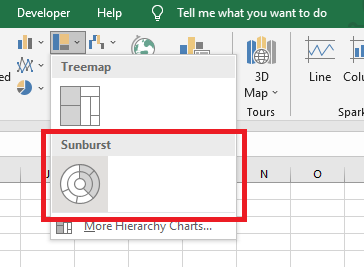
There is a second route. Click Insert > Recommended Charts > All Charts and pick Sunburst from the list. Worth knowing: Excel only volunteers a sunburst under Recommended Charts when your hierarchy contains blank cells, so most of the time it will not appear there on its own.
Rule to remember: Insert, Insert Hierarchy Chart, Sunburst is the reliable path. Recommended Charts is not.
How do you format the sunburst chart so it is readable?
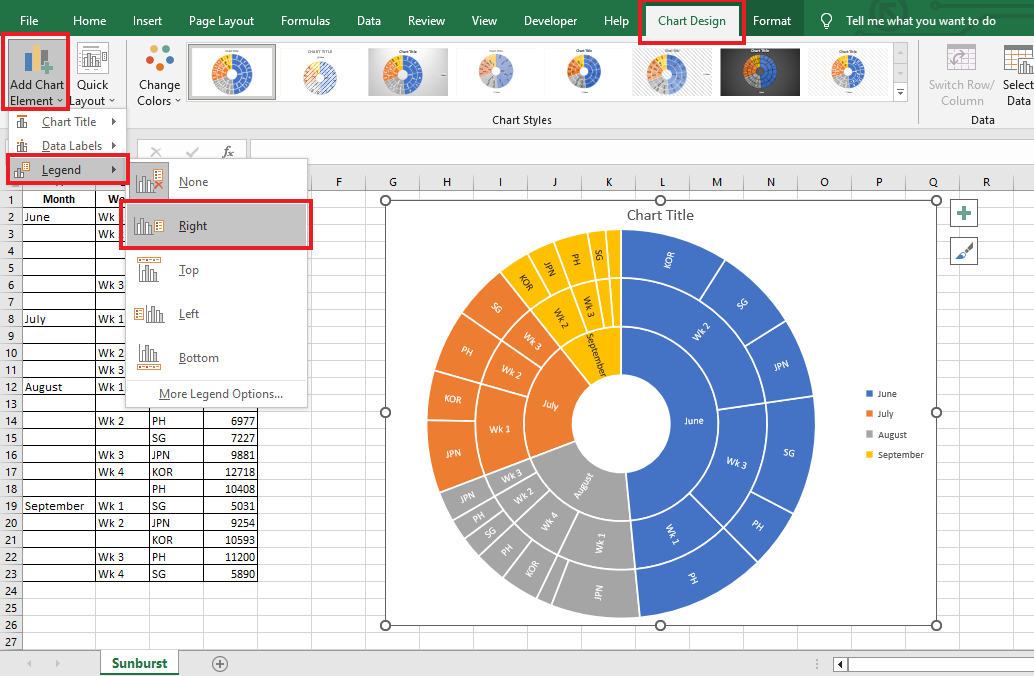
Click anywhere on the chart to bring up the Chart Design and Format tabs. If you do not see those tabs, the chart is not selected.
- On Chart Design, click Add Chart Element > Legend, then pick a position from the drop-down.
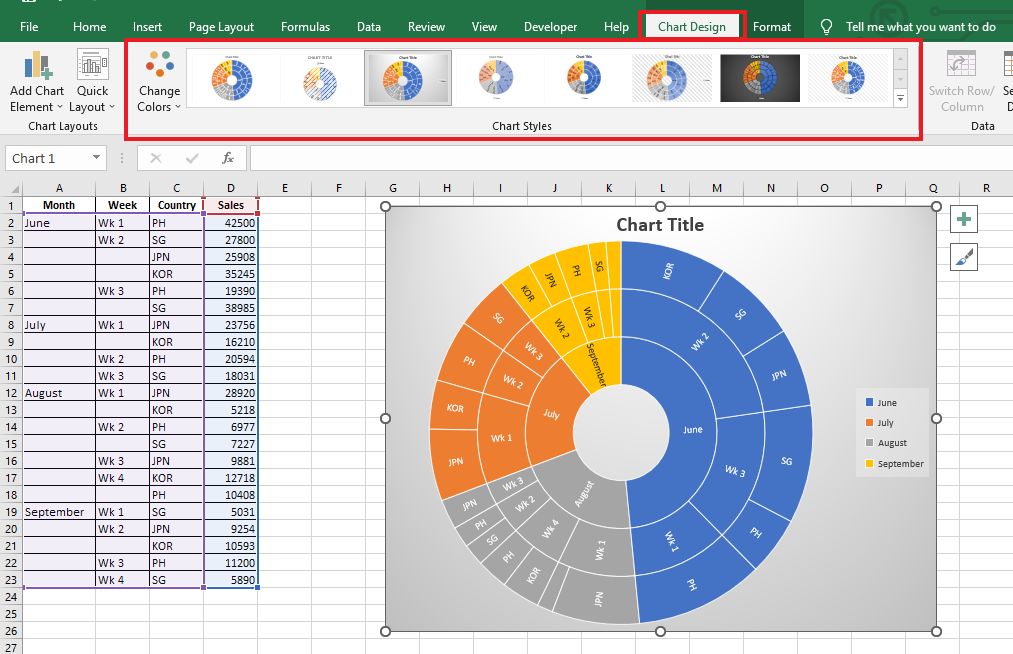
- Still on Chart Design, pick a Chart Style from the gallery.
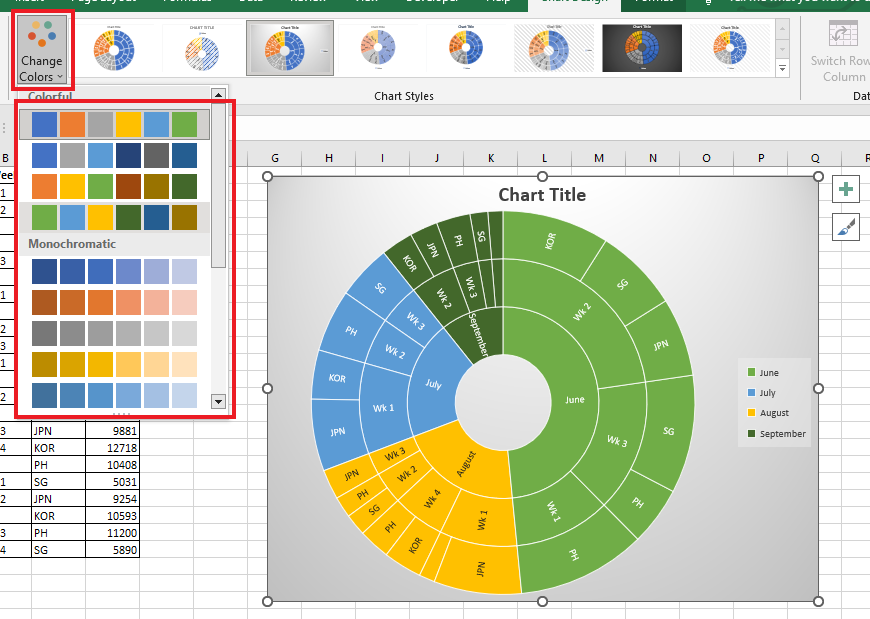
- Click Change Colors and choose a palette that separates your top-level categories cleanly.
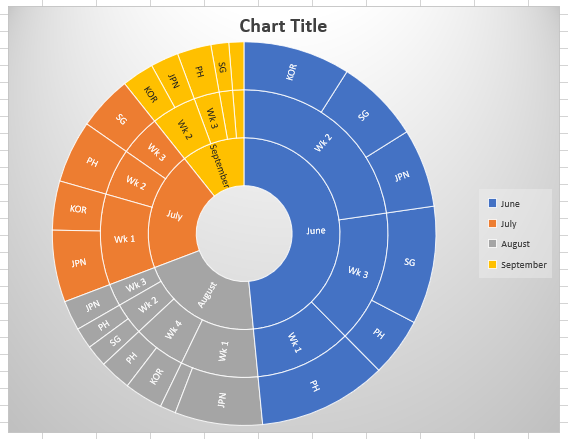
Two formatting details matter more than the style gallery. Right-click any ring and choose Format Data Labels to switch labels between category name and value. And if the outer ring labels are unreadable, that is not a formatting problem, it is a data problem: you have too many leaf categories for a circle to hold.
Rule to remember: if the outer ring is unreadable, cut categories rather than shrinking the font.
Read Also: How to Group Dates in Pivot Tables in Excel
How do you move a sunburst chart to its own sheet?
Excel coursework and grader tasks often ask you to insert a sunburst chart and move it to a new sheet with a specific name, such as SunburstChart. Doing it by dragging will not satisfy the grader, because it leaves the chart embedded in the worksheet. Use the Move Chart button instead.
- Click the chart once so its border is selected.
- Go to the Chart Design tab and click Move Chart on the far right.
- Choose New sheet in the dialog.
- Type the sheet name exactly as asked, for example SunburstChart, with no space.
- Click OK. The chart now occupies a dedicated chart sheet in the workbook tabs.
To reverse it, select the chart, click Move Chart again, choose Object in, and pick the worksheet.
Rule to remember: New sheet creates a chart sheet, Object in embeds the chart. Graders check for the first one.
Which Excel versions have the sunburst chart?
The sunburst chart was introduced in Office 2016 for Windows. Microsoft's Applies To list for the feature covers Excel for Microsoft 365, Excel 2024, 2021, 2019 and 2016 on Windows, the equivalent Mac releases, and Excel for iPad and iPhone.
Two practical consequences:
- Excel 2013 and earlier have no sunburst chart at all. There is no add-in from Microsoft that adds it. You would need to rebuild the effect with stacked doughnut charts or use a third-party add-on.
- Excel for the web is not on Microsoft's list for this feature. A sunburst created in the desktop app will display in the browser, but plan to build and edit it in desktop Excel.
Rule to remember: if you cannot find Insert Hierarchy Chart, check your Excel version before you check your data.
Why is the sunburst chart missing, greyed out, or wrong?
| What you see | Most likely cause | Fix |
|---|---|---|
| No Insert Hierarchy Chart button on the Insert tab | Excel 2013 or earlier, or Excel for the web | Build the chart in Excel 2016 or later on desktop |
| Chart buttons greyed out | The sheet is protected, or the workbook is in Compatibility Mode as an .xls file | Unprotect the sheet, or save as .xlsx and reopen |
| The chart looks like a plain doughnut | Only one category column was selected | Select every hierarchy column plus the value column |
| Rings are in the wrong order | Column order does not match the hierarchy | Reorder columns so the broadest level is furthest left |
| Some slices are missing | The value column contains text, or negative numbers | Convert values to numbers; sunburst charts cannot plot negatives |
| Outer labels overlap or vanish | Too many leaf categories for the space | Group small categories into an Other bucket, or enlarge the chart |
| An unexpected extra ring appears | A stray header or total row was included in the selection | Reselect the data range without totals |
Rule to remember: a sunburst that looks broken is almost always a selection problem, not a chart problem.
Is a starburst chart the same as a sunburst chart?
In Excel, yes in practice. A lot of people search for a starburst chart or a starburst graph when they mean the sunburst chart, and Excel has no chart type called starburst. If you are hunting the ribbon for one, go to Insert > Insert Hierarchy Chart > Sunburst.
The names do mean different things outside Excel. In general data visualization, starburst usually refers to a radial layout that fans lines or spokes out from a centre point, while sunburst specifically means nested rings representing a hierarchy. Excel only ships the second one.
Rule to remember: there is no starburst chart type in Excel, so search the ribbon for Sunburst instead.
Sunburst vs treemap vs doughnut: which should you use?
All three sit near each other in the Insert menu and all three show parts of a whole. They are not interchangeable.
| Chart | Best at | Levels it handles | Weak spot |
|---|---|---|---|
| Sunburst | Showing how one ring breaks into its contributing pieces | Two or more | Comparing two similar slice sizes by eye |
| Treemap | Comparing relative sizes across a hierarchy | Two or more | Making the hierarchy itself feel obvious |
| Doughnut | A single level split into parts | One | Anything hierarchical |
| Stacked bar | Precise comparison across categories | One or two | Showing proportions of a whole at a glance |
Microsoft draws the same line: the sunburst is most effective at showing how a ring is broken into its contributing pieces, while the treemap is designed for comparing relative sizes. If your reader's question is "how big is this compared to that," reach for the treemap or a bar chart. If the question is "what is this made of," use the sunburst.
Rule to remember: sunburst answers what something is made of, treemap answers how big things are.
Read Also: How To Make A Line Graph In Excel, Easy Tutorial
Can you make a sunburst chart in Google Sheets?
Google Sheets has no built-in sunburst chart type. Its chart list covers pie, doughnut, bar, column, line, area, scatter, treemap, and a few others, but the sunburst is not among them.
Three honest options if you are working in Sheets:
- Use a treemap instead. Google Sheets does have one, and it handles the same hierarchical data.
- Build it in Excel and paste the image in. Fastest route if the chart is for a report rather than a live dashboard.
- Use an add-on or a Google Charts embed. Google's own charting library includes a sunburst-style visual, but wiring it up means writing code.
Rule to remember: a sunburst request in Google Sheets becomes a treemap, an image, or a coding project.
Final thoughts
A sunburst chart rewards two minutes of preparation and punishes none. Get the column order right, put the value column last, and the chart builds itself in three clicks. Everything that goes wrong afterwards traces back to the selection or to asking a hierarchy chart to do a bar chart's job.
If you are visualizing categorical counts, such as defect types collected in a tally sheet template, a sunburst makes the hierarchy of categories instantly readable.
You can visit our home page for more easy-to-follow how-to and step-by-step guides, or browse the full library of Excel guides.
Frequently asked questions
How do you insert a sunburst chart in Excel?
Select your hierarchy columns and the value column, then click Insert, Insert Hierarchy Chart, and Sunburst. The chart is placed on the current worksheet. You can also reach it through Insert, Recommended Charts, All Charts, although Excel only recommends a sunburst when the hierarchy contains blank cells.
Where is the sunburst chart in Excel?
It lives on the Insert tab, inside the Charts group, under the Insert Hierarchy Chart button. That button holds two chart types: Treemap on the left and Sunburst on the right. If the button is not there, you are on Excel 2013 or earlier, or in Excel for the web.
What data do you need for a sunburst chart?
One column for each level of the hierarchy, ordered from broadest on the left to narrowest on the right, followed by a single numeric value column as the last column. Avoid merged cells, blank rows inside the block, total rows, and negative values.
Is there a sunburst chart generator I can use?
If you want to avoid building one manually, third-party Excel add-ons such as ChartExpo will generate a sunburst for you. They are worth considering mainly if you need styling options Excel does not offer, since the native chart takes three clicks.
Are there any disadvantages to using sunburst charts in Excel?
Yes. Readers judge angles poorly, so two slices of similar size are hard to compare, which is the same weakness pie and doughnut charts have. Outer rings also run out of room for labels quickly. Use a treemap or a bar chart when precise size comparison matters more than showing structure.
How do you move a sunburst chart to its own sheet in Excel?
Select the chart, go to the Chart Design tab, click Move Chart, choose New sheet, type the sheet name, and click OK. Dragging the chart does not count as moving it to its own sheet, because the chart stays embedded as an object in the worksheet.
Does Google Sheets have a sunburst chart?
No. Google Sheets has no sunburst chart type. The closest built-in equivalent is the treemap chart, which plots the same hierarchical data as nested rectangles instead of nested rings.
Related Articles:
What is a Sunburst Chart and When to Use a Sunburst Chart in Excel
Want to Make Excel Work for You? Try out 5 Amazing Excel Templates & 5 Unique Lessons
We hate SPAM. We will never sell your information, for any reason.

