
How To Use EDATE Function In Excel In 4 Easy Steps
Jun 01, 2023
✅ Quick Summary: How to Use the EDATE Function in Excel
The Excel EDATE function is designed to calculate specific future or past dates by adding or subtracting a set number of months from a start date. The syntax is simple: =EDATE(start_date, months). This function is essential for financial modeling, project management, and HR tasks, such as calculating maturity dates, contract expirations, or employee probation periods. Unlike simple addition formulas, EDATE automatically handles varying month lengths (28, 30, or 31 days) and leap years. If your result appears as a serial number (e.g., 44562), simply change the cell format to "Short Date." This guide covers the syntax, practical examples, and troubleshooting tips.
Get our free Excel formulas cheat sheet
Plus new tutorials and template drops. Enter your email and we'll send it over.
Table of Contents
Are you figuring out how to use the EDATE function in Excel?
Microsoft Excel can be hard to navigate, especially because of its complexity. But, using the steps we'll share, you can master using the excel edate function efficiently.
This blog post will teach you how to use the Excel EDATE function to automate your date calculations.
EDATE Function
The EDATE function is a built-in Excel feature classified under the DATE and TIME functions category.
It lets you retrieve a date corresponding to the same day of the month but a specified number of months in the past or future. The Excel EDATE function returns the serial date value, a specified number of months before or after the original start date.
The EDATE function in Excel is widely used to calculate expiration dates, maturity dates, and other due dates.
Note:
-
If you want to schedule a future date, use a positive value for months.
-
To schedule a date in the past, input a negative value for the months.
EDATE Function Syntax
The EDATE syntax requires two arguments:

-
Start_date - It's the initial date you need to enter. You must write it in the format of a date, either using the DATE function or with other formulas or functions.
-
Months - The Months argument is how many months before or after the "start_date." A positive number will give you a future date, while a negative number will give you a past date.
How to Use the EDATE Function
Here's an example to help you understand how to use the EDATE function:
-
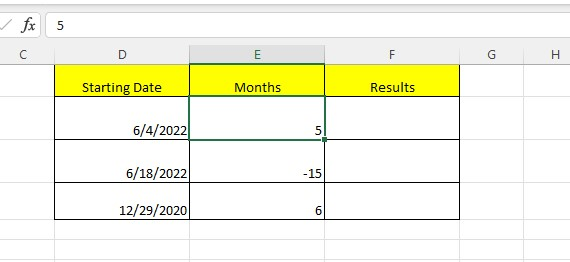
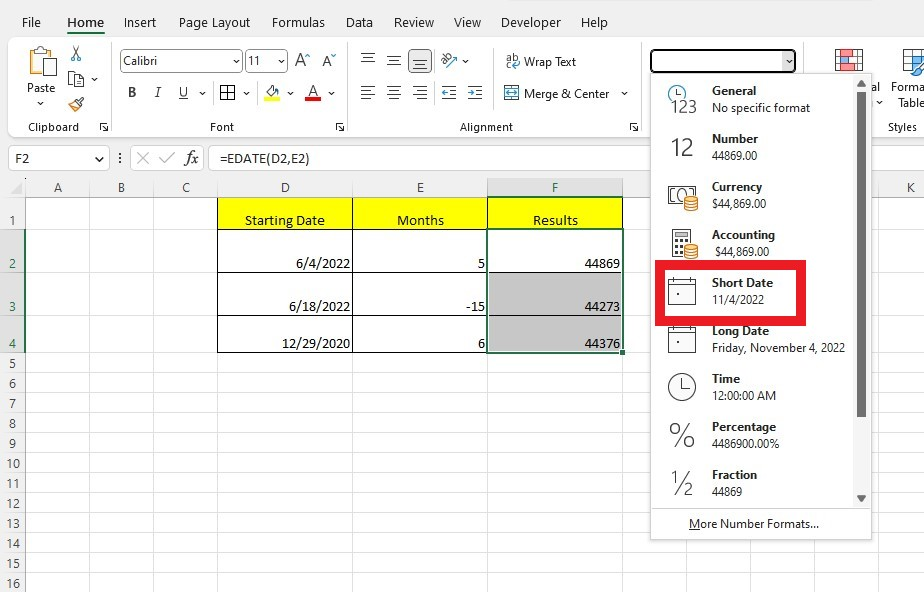
Prepare your list of dates with the number of months to add or subtract.
-
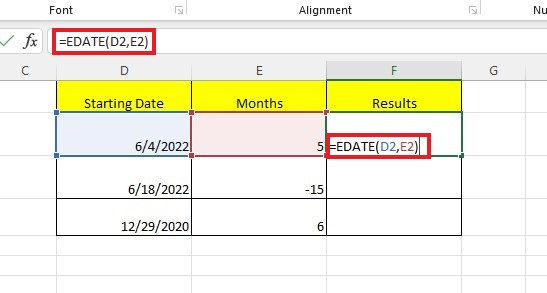
Type the EDATE function, the cell references of starting date, and the month's arguments.
-
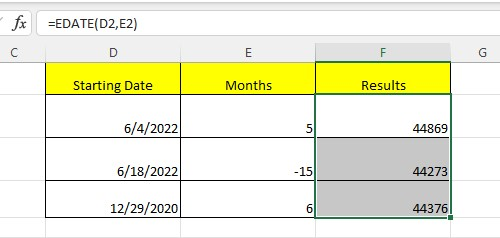
Press the Enter key, then use the Flash Fill feature (or Fill Handle) to fill in the other empty rows.
-
Go to the Home tab, click the General drop-down, then click the Short Date format.
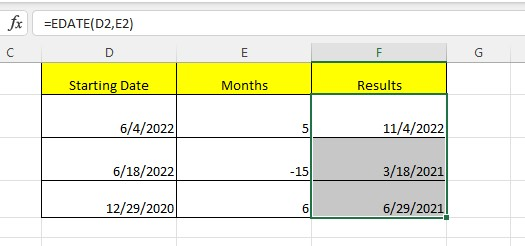
As you can observe, rows 2 and 4 return the sum value of months. Meanwhile, row 3 returns a difference since "-15" is negative.
Pro Tip: Using EDATE to Add Years
While EDATE is designed for months, you can easily use it to add years to a date without complicated formulas. Since there are 12 months in a year, you simply multiply the number of years by 12 inside the formula.
Formula: =EDATE(A2, 12*5)
This formula adds exactly 5 years (60 months) to the date in cell A2. This is much safer than simply adding 365 days, as it correctly handles leap years.
EDATE vs. EOMONTH
Many users confuse EDATE with EOMONTH. Here is the quick difference:
| Function | Description | Example Result |
|---|---|---|
| EDATE | Returns the exact same day X months later. | Jan 15 + 1 Month = Feb 15 |
| EOMONTH | Returns the last day of the month X months later. | Jan 15 + 1 Month = Feb 28 |
Troubleshooting Common Errors
Why is my date showing as a number (e.g., 44562)?
The EDATE function generates a serial number representing a date. Excel stores dates as serial numbers (starting from Jan 1, 1900). To fix this, select the cell and change the format from "General" or "Number" to "Short Date."
#NUM! and #VALUE! Errors
- #NUM! Error: Occurs if the "start_date" or the first argument is invalid.
- #VALUE! Error: Occurs if the start_date provided is not a valid Excel date (e.g., text) or if the months argument is non-numeric.
Final Thoughts on How to Use Edate Function In Excel
As you can see, the EDATE function in Excel is valuable and can save you time and energy when dealing with recurring dates.
Moreover, understanding how to use it correctly with your spreadsheet data will make your job much easier and more efficient.
Visit Simple Sheets for more easy-to-follow guides, and remember to check out the related articles section of this blog post.
For the most straightforward Excel video tutorials, subscribe to Simple Sheets on Youtube!
Frequently Asked Questions on How To Use Edate Function In Excel
Can I use the EDATE function to add days?
No, the EDATE function works only with months. If you want to add days (e.g., add 30 days), simply use the addition operator: =A1 + 30. Do not use EDATE for daily calculations unless you are converting days to months.
How can I differentiate EDATE and EOMONTH functions?
- EDATE: Returns a date on the same day of the month, X months in the future or past.
- EOMONTH: Returns the last day of the month, X months in the future or past.
How can I add Years using EDATE?
To add years, multiply the number of years by 12 in the months argument. For example, to add 3 years to date A1: =EDATE(A1, 12*3).
How can I keep the time value using the EDATE function?
To keep time, use the MOD function to extract time from the DateTime value and add it to the EDATE result: =EDATE(A1, B1) + MOD(A1, 1).
Related Articles:
The Easiest Guide You Must Have: Excel Histogram
Want to Make Excel Work for You? Try out 5 Amazing Excel Templates & 5 Unique Lessons
We hate SPAM. We will never sell your information, for any reason.

