
The Only Guide You'll Need For Excel Strikethrough
Apr 27, 2023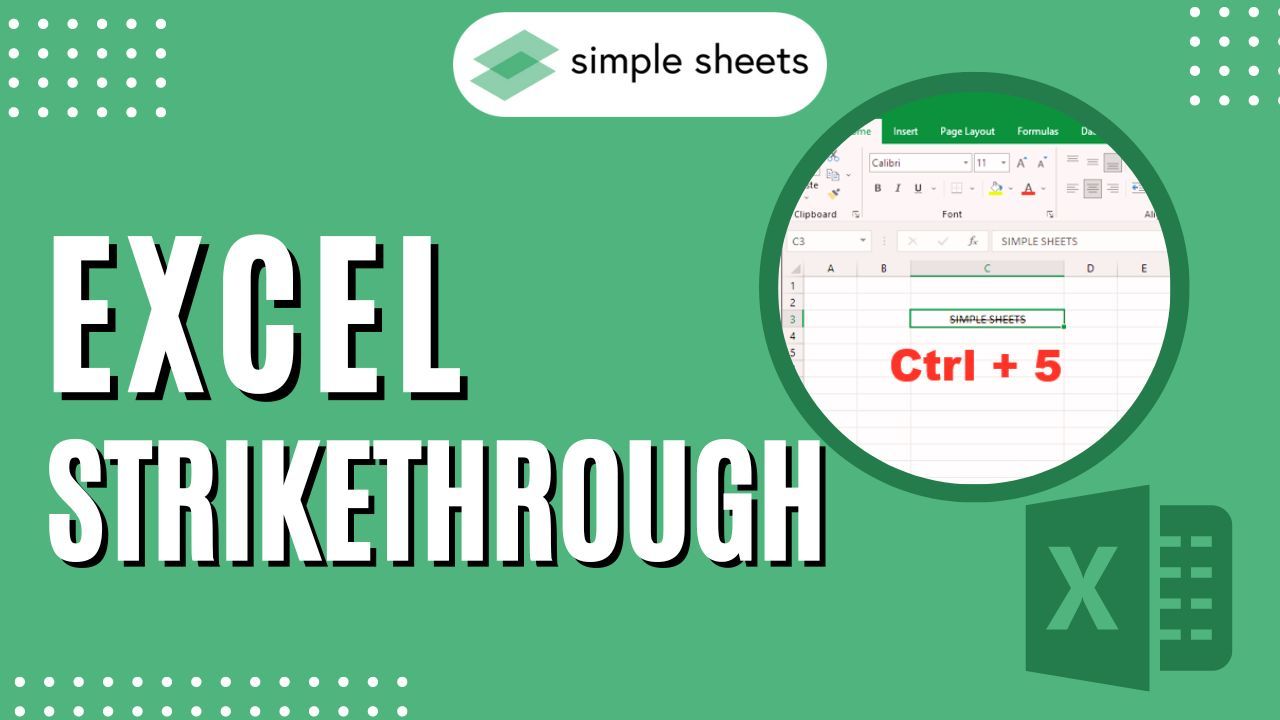
Strikethrough draws a line through text without deleting it, which is why it is the fastest way to mark a task done, an invoice paid, or a line item cancelled while keeping the original record on the sheet.
Answer: To apply strikethrough in Excel, select the cells or highlight the characters, then press Ctrl + 5 on Windows or Command + Shift + X on Mac. The same shortcut removes it. If the shortcut does nothing, open Format Cells with Ctrl + 1, go to the Font tab, and tick Strikethrough under Effects.
Last updated: August 19, 2026
Get our free Excel formulas cheat sheet
Plus new tutorials and template drops. Enter your email and we'll send it over.
What this guide covers:
- What is strikethrough in Excel, and when should you use it?
- What is the Excel strikethrough shortcut on Windows and Mac?
- How do you apply strikethrough from the ribbon or the right-click menu?
- How do you add a strikethrough button to the Quick Access Toolbar?
- How do you strike through only part of the text in a cell?
- How do you strike through a cell automatically when a task is marked done?
- How do you remove strikethrough in Excel?
- How do you cross out an entire cell with a diagonal line?
- How do you find, count, or filter cells that have strikethrough?
- Why is strikethrough not working in Excel?
- Frequently asked questions about Excel strikethrough
What is strikethrough in Excel, and when should you use it?
Strikethrough is a font effect that draws a horizontal line through the characters in a cell. It changes how the text looks and nothing else. The value stays intact, formulas that reference the cell still return the same result, and SUM keeps counting the number.
Rule of thumb: reach for strikethrough when the record needs to stay visible and auditable. Delete the row when it should disappear.
That distinction matters more than it sounds. A struck-through line on a purchase order tells the next person the item was considered and dropped. A deleted row tells them nothing at all.
Typical uses:
- Marking finished items on a to-do list without losing the history of what was on it. Our weekly to-do list template walks through building the list itself.
- Tracking shared project work, so collaborators can see what is closed and what is still open. For recurring work, a project task list template gives you one place to track open items, then strikethrough marks completed tasks without deleting the original record.
- Flagging superseded figures in a budget or forecast, where the old number needs to stay on the page for comparison.
- Marking discontinued inventory lines so nobody reorders them, while the SKU history survives.
Strikethrough formatting behaves the same way across Word, Excel, and most spreadsheet tools, so the habit carries over.
What is the Excel strikethrough shortcut on Windows and Mac?
The shortcut is different on each platform, which is the single most common reason people think strikethrough is missing from their copy of Excel.
| What you want to do | Windows | Mac |
|---|---|---|
| Apply or remove strikethrough | Ctrl + 5 |
Command + Shift + X |
| Open the Format Cells dialog | Ctrl + 1 |
Command + 1 |
| Strike only some characters in a cell | Double-click into the cell, drag over the words, then Ctrl + 5 |
Double-click into the cell, drag over the words, then Command + Shift + X |
| Repeat the same formatting on the next selection | F4 |
Command + Y |
The shortcut is a toggle, not a one-way switch. Pressing it a second time on the same selection clears the line.
Two things trip people up. The 5 has to be the one on the number row above the letters, because the numeric keypad 5 does not register for this. And if your selection contains a mix of struck and unstruck cells, the first press applies strikethrough to all of them rather than clearing the ones that already had it. Press it twice to clear the whole selection.
Microsoft keeps the full list of platform shortcuts in its keyboard shortcuts in Excel reference.
How do you apply strikethrough from the ribbon or the right-click menu?
Excel has no dedicated Strikethrough button sitting on the Home tab the way Bold and Italic do. Both menu routes end in the same place, the Font tab of the Format Cells dialog.
Method 1: the Home tab
Use this route when you want to change several font settings at once, since the dialog also holds colour, underline, and superscript.
-
Select the cells you want to format, then go to the Home tab.

-
In the Font group, click the small Font Settings arrow in the bottom-right corner.

-
The Format Cells dialog box opens.

-
Go to the Font tab.

-
Under Effects, tick Strikethrough.

-
Click OK to apply it.

Method 2: the right-click menu
This skips the ribbon entirely and is usually two clicks faster.
-
Select the cells, then right-click and choose Format Cells.

-
Switch to the Font tab and tick Strikethrough under Effects.

-
Click OK.

If you would rather learn the whole dialog, our Microsoft Excel tutorial covers the other tabs.
How do you add a strikethrough button to the Quick Access Toolbar?
If you strike cells out dozens of times a day, put the command on the Quick Access Toolbar so it is one click from anywhere in the workbook.
Right-click any empty part of the ribbon and choose Customize Quick Access Toolbar. Excel Options opens on the right page.

-
In the drop-down menu labelled Choose commands from, select All Commands.
-
Scroll the alphabetical list to Strikethrough and select it.
-
Click Add to move it into the Quick Access Toolbar panel on the right.
-
Click OK.

The icon now sits in the small toolbar above or below the ribbon. Select cells and click it once to toggle strikethrough.

Every Quick Access Toolbar button also gets a number shortcut. If Strikethrough lands in the third slot, Alt + 3 fires it.
The Quick Access Toolbar is per user and per machine, not per workbook, so the button follows you to every file you open on that computer but does not travel with the file to a colleague.
How do you strike through only part of the text in a cell?
Selecting a cell and pressing the shortcut strikes everything in it. To strike a single word, you have to be inside the cell in edit mode first.
-
Double-click the cell, or select it and press F2, then drag across just the characters you want crossed out.

-
Open the Font settings from the Home tab, or press
Ctrl + 1, and tick Strikethrough.
-
Click OK. Only the highlighted characters get the line.

Ctrl + 5 works in edit mode too, and on Mac you can use Command + Shift + X or open the dialog with Command + 1.
Character-level formatting is fragile. Retype or overwrite the cell and the partial strikethrough is gone, because Excel stores it against the characters rather than the cell.
Two consequences worth knowing. Partial strikethrough only survives in a cell holding literal text, so a cell containing a formula cannot have half its result struck out. And conditional formatting cannot do partial strikethrough at all, because rules apply to whole cells.
How do you strike through a cell automatically when a task is marked done?
This is the version most people actually want. Instead of striking each row by hand, a conditional formatting rule watches a status column and crosses the row out the moment it says Done.
-
Select the range you want the rule to govern, for example the task names in column A.

-
On the Home tab, click Conditional Formatting in the Styles group, then New Rule.

-
Choose "Use a formula to determine which cells to format".

Write the formula against the first cell of the selection only. If your status sits in column B and the selection starts in row 3, enter
=$B3="Done". The dollar sign locks the column so the rule spreads sideways across the row, while the row number stays relative so it steps down the list. -
Click Format.

-
On the Font tab, tick Strikethrough, then click OK.

-
Click OK again to save the rule.

Conditional formatting strikethrough is display only. It never edits the cell, so no formula, sort, or SUM downstream sees any difference.
Pair the rule with a tick box for a genuinely one-click list. Insert a checkbox from Developer, link it to a helper cell, then point the rule at that cell with =$C3=TRUE. Our guide to Excel checkboxes covers the linking step, and the conditional formatting guide covers rule order and precedence when you stack several rules on one range.
One gotcha: text comparisons in conditional formatting ignore case but not stray spaces. "Done " with a trailing space will not match ="Done". Wrap the reference in TRIM if your status column is typed by hand, as in =TRIM($B3)="Done".
How do you remove strikethrough in Excel?
How you remove it depends entirely on how it got there, which is why the shortcut sometimes appears to do nothing.
- Applied manually: select the cells and press
Ctrl + 5again, orCommand + Shift + Xon Mac. Untick the box in Format Cells if you prefer the dialog. - Applied to some characters only: double-click into the cell, select the struck characters, and toggle the shortcut. Selecting the whole cell and toggling once will strike everything else instead, so press twice if that happens.
- Applied by conditional formatting: the shortcut will not touch it. Go to Home, Conditional Formatting, Manage Rules, set "Show formatting rules for" to This Worksheet, and delete or edit the rule.
- Applied everywhere and you want a clean slate: Home, Clear, Clear Formats wipes strikethrough along with every other format on the selection, including number formats and fills.
If pressing the shortcut does nothing at all, the line is coming from a rule rather than the cell. Check Manage Rules before anything else.
How do you cross out an entire cell with a diagonal line?
Strikethrough follows the text, so a short word gets a short line and an empty cell gets nothing. When you want a line right across the cell, whether or not it holds any text, use a diagonal border instead.
- Select the cells and press
Ctrl + 1to open Format Cells. - Go to the Border tab.
- In the preview box, click the diagonal button in the lower-right group. There are two, one for each direction, and you can use both to draw an X.
- Click OK.
| Strikethrough (Font effect) | Diagonal border | |
|---|---|---|
| What it crosses | Only the characters present | The full width and height of the cell |
| Works on an empty cell | No, there is nothing to strike | Yes |
| Survives retyping the contents | Cell level yes, character level no | Yes, borders are independent of contents |
| Can be driven by conditional formatting | Yes, on the Font tab of the rule | Yes, on the Border tab of the rule |
| Best for | Completed line items you still want to read | Blocking out cells that must not be filled in |
Use the diagonal border for "do not use this cell" and strikethrough for "this is finished".
How do you find, count, or filter cells that have strikethrough?
Sort and Filter read cell values, never font formatting, so neither one can see a strikethrough. There are two honest workarounds.
Find every struck cell without any code
Excel's Find dialog can search by format, which most people never notice.
- Press
Ctrl + F, then click Options to expand the dialog. - Click Format, go to the Font tab, tick Strikethrough, and click OK. Leave the "Find what" box empty.
- Click Find All. Every match appears in the list at the bottom.
- Click into the results list and press
Ctrl + Ato select all the matching cells on the sheet at once, ready to recolour, clear, or delete.
Remember to click Format, then Clear Find Format afterwards, or your next search will silently return nothing.
Count or filter with a helper column
To sort, filter, or count struck rows you need the formatting turned into a value, which takes a short user-defined function. Press Alt + F11, choose Insert then Module, and paste:
Function IsStruck(c As Range) As Variant
IsStruck = c.Font.Strikethrough
End Function
Enter =IsStruck(A2) in a helper column and fill it down. TRUE means the whole cell is struck, FALSE means none of it is, and a cell with a mix of struck and unstruck characters returns neither, which is a useful signal in itself. You can then filter that column, or count with =COUNTIF(C2:C200,TRUE).
Excel does not recalculate when only formatting changes. After you strike new cells, press Ctrl + Alt + F9 to force a full recalculation or the helper column will show stale results.
Save the file as .xlsm, since a workbook with a macro in it cannot be stored as .xlsx.
Why is strikethrough not working in Excel?
Almost every report of a broken strikethrough comes down to one of these six causes.
| What you see | Why it happens | Fix |
|---|---|---|
Ctrl + 5 does nothing |
You pressed 5 on the numeric keypad, or the sheet is protected | Use the 5 on the number row above the letters. For a protected sheet, go to Review then Unprotect Sheet |
| The Strikethrough checkbox is greyed out | The sheet or workbook is protected, or the file opened read-only or in Protected View | Unprotect the sheet, or click Enable Editing in the banner at the top of the window |
| The shortcut does nothing on a Mac | Ctrl + 5 is a Windows binding |
Use Command + Shift + X, or Command + 1 and the Font tab |
| The whole cell got struck when you wanted one word | The cell was selected rather than the characters inside it | Double-click into the cell first, drag over the words, then apply |
| The strikethrough vanished after you retyped the cell | Character-level formatting is discarded when the contents are replaced | Apply strikethrough to the whole cell instead, or reapply after editing |
| The shortcut refuses to clear an existing line | The line comes from a conditional formatting rule, not the cell | Home, Conditional Formatting, Manage Rules, then edit or delete the rule |
Final thoughts on Excel strikethrough
Strikethrough is a five-second job once you know which of the three layers you are dealing with. Manual formatting for one-off crossings, a conditional formatting rule when a status column should drive it, and a diagonal border when the cell itself needs blocking out. Everything else in this guide, from the Quick Access Toolbar button to the Find by format trick, is just a faster way to reach one of those three.
For more easy-to-follow guides, visit Simple Sheets and the Related Articles section of this blog post. Subscribe to Simple Sheets on Youtube for the most straightforward Excel video tutorials.
Frequently asked questions about Excel strikethrough
What is the Excel strikethrough shortcut on Windows and Mac?
On Windows it is Ctrl + 5, using the 5 on the number row rather than the numeric keypad. On Mac it is Command + Shift + X. Both are toggles, so pressing the same keys again on the same selection removes the line.
Is there a strikethrough function or formula in Excel?
No. Strikethrough is font formatting, not a worksheet function, so there is nothing to type into a cell. Apply it with the keyboard shortcut, the Font tab of Format Cells, or a conditional formatting rule. In VBA it is available as the Range.Font.Strikethrough property.
Can I sort or filter cells by strikethrough in Excel?
Not directly, because Sort and Filter read values and ignore font formatting. Two workarounds exist. Use Ctrl + F, click Options then Format, tick Strikethrough, and click Find All to select every struck cell at once. Or add a helper column using a short user-defined function that returns Range.Font.Strikethrough, then filter or count on that column.
Why is the strikethrough option greyed out in Format Cells?
Greyed out almost always means the sheet or workbook is protected. Go to Review and click Unprotect Sheet, entering the password if there is one. It can also happen when the file opened read-only or in Protected View, in which case click Enable Editing first.
How do I strike through only one word inside a cell?
Double-click the cell to enter edit mode, or press F2, then drag across just the characters you want crossed out and press Ctrl + 5. Selecting the cell without entering edit mode strikes the entire contents instead. This character-level formatting is lost if you later retype the cell.
Does conditional formatting work for partial strikethrough?
No. Conditional formatting rules apply to whole cells, so a rule can strike an entire cell but never a single word inside it. If you need part of the text struck automatically, split that text into its own cell and point the rule at it.
Related Articles:
A Practical Guide To Add Header And Footer In Excel
How To Insert Icons In Excel: Everything You Need To Learn
How To Add Cells In Excel in 4 Simple Steps
Want to Make Excel Work for You? Try out 5 Amazing Excel Templates & 5 Unique Lessons
We hate SPAM. We will never sell your information, for any reason.

